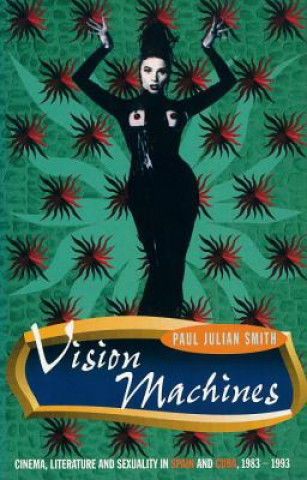
Kniha Vision Machines Paul Julian Smith

Vision Machines

Cinema, Literature and Sexuality in Spain and Cuba, 1983-1993

Jazyk: Angličtina
Väzba: Brožovaná
Vydavateľ: Verso Books
Dostupnosť: 50 % šanca
Prehľadáme celý svet
17.04
Over the last decade, visibility and sexuality have become a major theme in Spanish and Cuban cinema...


Informácie o knihe

Jazyk
Angličtina
Väzba
Kniha - Brožovaná
Vydalo
1996
Stránok
180
EAN
9781859840795
Enbook ID
05119926
Vydavateľ
Hmotnosť
377
Rozmery
152 x 234 x 18

Kompletný popis

Over the last decade, visibility and sexuality have become a major theme in Spanish and Cuban cinema, literature and art. Vision Machines explores this development in the light of contemporary history and recent theoretical accounts of sight by writers including Paul Virilio, Gianni Vattimo and Teresa de Lauretis. The very visible women of Almodovar's cinema are Paul Julian Smith's first subject. He shows how, in his early Dark Habits, lesbianizes the look, putting women's pleasure at the centre of the frame, and then examines Almodovar's recent film, Kika, where the conflict between cinema and video is played out in the bodies of women: good, bad and ugly. Moving the focus to Cuba, Smith discussed the reception in Europe and North America of Nestor Almendro's remarkable documentary on gays in Cuba, Improper Conduct, and traces the trial of visibility to which effeminate men were exposed. He compares Amendor's work with the autobiography of exile novelist Reinaldo Arenas, which revels in graphic sex, and also looks at the first Cuban film with a gay theme, Gutierrez Alea's Strawberry and Chocolate. Smith returns to Spain to consider the response of artists and intellectuals to the public invisibility of AIDS in a country with one of the highest rates of HIV transmission in the Eurpean Union. Drawing on Anglo-American debates on the representation of AIDS, he concentrates on the one major intervention by Spanish scholars and artists, Love and Rage, and on the only figure in any medium to address AIDS in his aesthetic practice, the conceptual artist and video-maker Pepe Espaliu. He concludes with a fascinating account of Julio Medem's pathbreaking film from 1993, The Red Squirrel, which has opened up a new approach to two formerly taboo subjects: Basque nationalism and female sexuality.

Mohlo by vás zaujímať

128.44

Howl's Moving Castle

Diana Wynne Jones
16.94

Reputation Management

Santino Spencer
11.65

A Time to Love

Tracy Higley
10.28

The Plum Tree

David Graham Phillips
19.59
255.43

Biblical Antiquities

P. W. Raidabaugh
15.67

N Nitrogen

Reinhard Haubold
578.47

Hagakure

Yamamoto Tsunetomo
14.88

Flight of the Mind

Thomas C. Caramagno
67.70
33.01

Zákazníci, ktorí si kúpili túto knihu, kúpili tiež

Handbuch Literaturkritik

Sabine Brenner-Wilczek
93.27
5.87
9.40