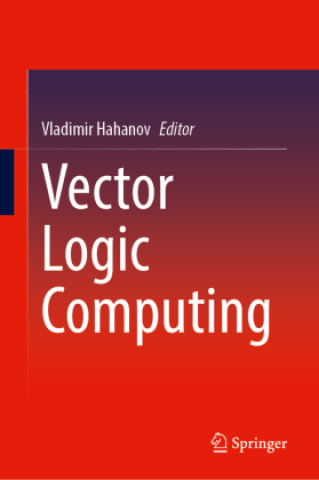
Kniha Vector Logic Computing Vladimir Hahanov

Vector Logic Computing

Jazyk: Angličtina
Väzba: Pevná
Vydavateľ: Springer-Verlag GmbH
Dostupnosť: Očakávaná novinka
Vydanie 30. 06. 2026
179.78
This book creates a non-processor economy vector logic in-memory computing based on read-write trans...

Informácie o knihe

Jazyk
Angličtina
Väzba
Kniha - Pevná
Vydalo
2026
Stránok
1013
EAN
9783032070005
ISBN
3032070007
Enbook ID
49531036

Kompletný popis

This book creates a non-processor economy vector logic in-memory computing based on read-write transactions on logical vectors, truth tables, and matrices. In-memory vector logic is a harmonic relationship between a model and an algorithm that aims to reduce time and energy in modeling for simulation by using additional space and matter. Vector logic is an ideal form of representation of functions and structures for modelling and simulating social and physical processes. Modeling without simulation is a prompt-computing for creating a comprehensive testing map of any functionality or structure on a logical vector. Intelligent computing is here the integration of classical and artificial intelligence mechanisms for modeling and simulation, using vector-logical and matrix models to process functions and structures. The book first discusses the development of smart vector logic data structures to reduce the computational complexity of simulation algorithms. Then it explores the creation of mechanisms for vector logic modeling and testing, leveraging truth tables and matrices built on a logical vector. After that, novelty goes on to cover the following: vector testing of logic circuits by simulating faults as addresses of logical vector bits; vector testing of graph structures by simulating transition faults as truth table addresses, and vector logic in-memory computing of unitary-encoded big data as truth table addresses. The book then explores the logical vector modeling for the simulation of social processes via unitary pattern encoding on the universe primitives. The goal of cyber-social vector logic computing is energy-effective monitoring and moral management of cyber-social processes and phenomena. Vector logic is a functional and structural relationship for in-memory computing, which forms an exponentially redundant data structure in memory to minimize its processing time and energy. The original vector logic mechanisms are implemented in the MOSI cloud service Modeling for Simulation, written in Python, for simulating good-value states and faults, as addresses for logical circuits, functionalities, and structures. The book can be helpful for specialists in the field of big data prompt computing, including social and physical processes, as well as for engineers involved in testing digital GL, RTL, and system-level projects, automatic test generation, and good-value and fault address simulation. The theory and practice of vector-logical computing, algorithms, models, mechanisms, and codes are an original development to create energy- and time-saving processor-less new computing in memory.

Mohlo by vás zaujímať

41.45
25.73
9.42
14.33

Blood Bound

Ellis Hunter
22.98
29.56

Hollow Kingdom

BUXTON KIRA JANE
13.65

Art of the Beard

Angie Sacks
23.47
19.44
199.82

Tatiyana

Nickolas Johann Raderick
10.99
94.50

London Fields

Martin Amis
10.70
20.82

Zákazníci, ktorí si kúpili túto knihu, kúpili tiež

Vintage Rennräder

Philipp Horak
30.35
10.99

Ojos de Dragón III

SANTIAGO GARCIA-CLAIRAC
23.47

The Wolf King

Kerstin Fricke
20.52

Vitinha

Pernia
13.25

Virtuelle Landschaften

Manuel van der Veen
39.98

veglia del sangue

Emanuele Torreggiani
22.59

Werner Robert Schaub

Eckart Würzner
15.22
10.70

Osudná kniha

Karel Sabina
12.43
24.36
11.88