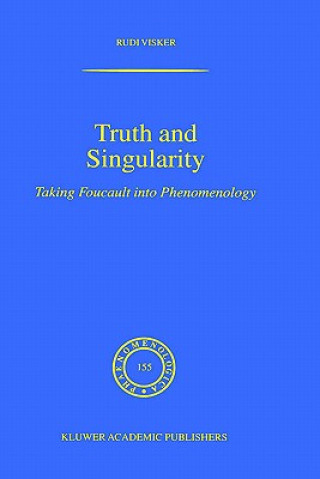
Kniha Truth and Singularity R. Visker

Truth and Singularity

Taking Foucault into Phenomenology

Autor: R. Visker
Jazyk: Angličtina
Väzba: Pevná
Vydavateľ: Springer
Dostupnosť: Skladom u dodávateľa
Odosielame za 10-13 dní
198.83
The aim of these essays is to disentangle us from the opposition between universalism and relativism...

Informácie o knihe

Autor
Jazyk
Angličtina
Väzba
Kniha - Pevná
Vydalo
1999
Stránok
412
EAN
9780792359852
ISBN
0792359852
Enbook ID
02106145
Vydavateľ
Hmotnosť
1710
Rozmery
170 x 244 x 27

Kompletný popis

The aim of these essays is to disentangle us from the opposition between universalism and relativism in which so many of the debates in recent contemporary philosophy have been caught. This volume shows that what is in fact returning in these discussions and maneuvering them into a pre-set course is the very ambiguity, `the subject', which they seek to repress.The aim of these essays is to disentangle us from the opposition between universalism and relativism in which so many of the debates in recent contemporary philosophy have found themselves caught. Unsurprisingly so, for, as this volume shows, what is in fact returning in these discussions and manoeuvring them into a pre-set course is the very ambiguity which they seek to repress. The name of that ambiguity is, of course, `the subject', but a subject whose finitude seems to have left it with a burden which it did not wait for philosophy to take over. Racism, ethnocentrism and multiculturalism owe their dynamics to a tension at the heart of the subjectivity of a subject which not only lost its place at the centre, but also found its place outside of that centre to be less than comfortable. As the collision between phenomenology (Heidegger, Merleau-Ponty, Sartre, Levinas) and post-structuralism (Foucault, Lacan, Derrida) enacted in this volume forces one to conclude, such a decentred subject is all but dead. It is attached to `something' to which it does not find access and from which it cannot rid itself, because it is that to which it owes its singularity. §The inflation of particularisms in our contemporary societies betrays an attempt to appropriate that `something' and thus to provide man with the roots he misses. But no less one-sided are the attempts of those who in response to this try to locate man's `deepest essence' (Levinas) in an uprootedness `beyond' or `before' any such rootedness. Particularism and its critics are each in their own way recentring a decentred subjectivity characterized for one and the same reason by both `too many' and `too few' roots. §Such is human dignity: what makes us irreplaceable is at once that from which we suffer and would like to be relieved of. It is that metaphysical unrest in man which obliquely manifests itself in the problem of `difference' with which our societies find themselves confronted and in which they conspicuously can only recognize an ethicalpolitical dimension. What is thus excluded is that part of the subject which does not respond to others because it does not even respond to the subject itself. An exclusion in which one can suspect the legacy of a modernity prone to horizontalize a transcendence which it found unoccupied. Paradoxical as it may seem, something of a verticality in man that refuses to bow to such a horizontalization and to what one calls `the world' seems to have been preserved in the stubbornness with which relativism, if one is to believe its critics, keeps refuting itself. We propose to call that something `transdescendence'.

Mohlo by vás zaujímať

Philosophy of Physics

Roberto Torretti
47.01

Patty's Friends

Carolyn Wells
25.60

God Who Lives

Adam Pryor
28.24
7.62

Bucolic Metaphors

Rosilie Hernández-Pecoraro
34.99
217.11
29.90
17.49

Talk to Win

Shamshir Rai Luthra
5.37
41.73

Error of the Pagan Religions

Julius Firmicus Maternus
30.20
222.29

Wild Cards: Jokers Wild

George R. R. Martin
14.26
104.59
20.62
34.30
17.78

Zákazníci, ktorí si kúpili túto knihu, kúpili tiež

12.89
45.64
17.68