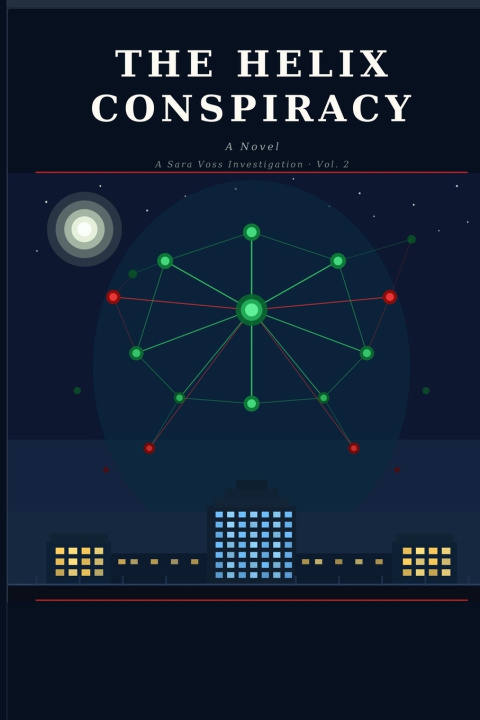
A body on the NIH perimeter fence. A name in a dead man's shoe. And a classified program that has been running for eight years without congressional oversight.
When Montgomery County Detective Sara Voss is called to the NIH campus at five in the morning, she finds what she has learned to recognize: a body arranged with deliberate care, no obvious cause of death, and a single folded piece of paper hidden inside the dead man's shoe. The name on the paper is Dr. Nathan Flynn - founder of Helix Dynamics, the most advanced AI-powered genomics platform in existence.
Flynn is a molecular geneticist who has spent a decade building a digital twin of human biology: a living computational model capable of mapping genetic vulnerability in any tissue, in any population, in real time. He built it to find cures. Someone else has been using it to find targets.
OPERATION HELIX is a classified joint National Security Agency (NSA) / Central Intelligence Agency (CIA) program with no congressional notification and a single scientific dependency: the convergence architecture at the heart of Flynn's platform. For fourteen months, government assets have been infiltrating Helix Dynamics, stealing the methodology piece by piece. Now, with the platform approaching its most powerful iteration, the program is ready to move from acquisition to deployment.
The weapon they are building is unlike anything in the forensic or military literature: a pathogen designed not for broad lethality but for population-specific precision, engineered to exploit genetic chokepoints shared by specific ethnic and geographic groups. The science is real. The targeting is real. And the man whose published gene networks made it possible has just found a dead Russian American computational biologist's final message asking him to stop it.
Flynn is a scientist. He documents. He builds redundancy into every system he touches. He has never operated outside a laboratory context or a boardroom. Voss is a detective with a cold case that just reopened and a federal government that has been trying to bury it for two and a half years.
Together, they have eleven days before the validation phase completes and a planned weapon becomes a deployed one.
The science is real. The author is a molecular geneticist with 35 years of experience, faculty member at The Johns Hopkins University School of Medicine with AI training at MIT, and an active NIH Research Collaboration Agreement. The dual-use implications of AI-powered genomics are a live policy debate. This is where that debate becomes a story.
For readers of Patricia Cornwell, Robin Cook, and Richard Preston.