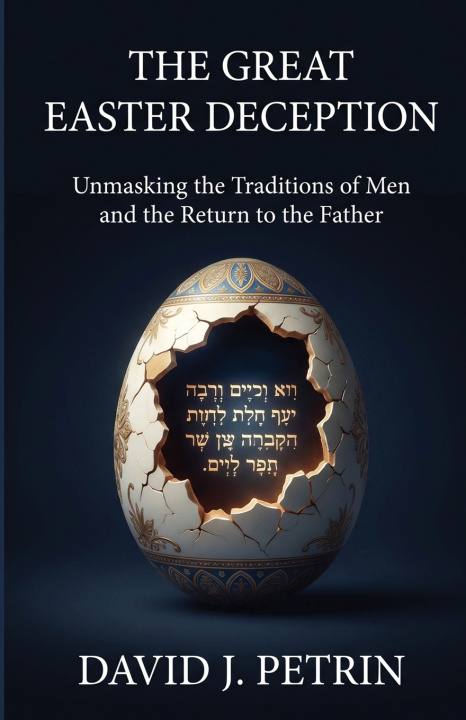
Kniha The Great Easter Deception David J Petrin

The Great Easter Deception

Unmasking the Traditions of Men and the Return to the Father

Jazyk: Angličtina
Väzba: Brožovaná
Vydavateľ: DJRIDES
Dostupnosť: Skladom u dodávateľa
Odosielame za 8-11 dní
15.29
Book OverviewThis manuscript serves as a diagnostic audit of contemporary religious practices, chall...

Informácie o knihe

Jazyk
Angličtina
Väzba
Kniha - Brožovaná
Vydalo
2026
Stránok
46
EAN
9798256110383
Enbook ID
53224746
Vydavateľ
Hmotnosť
67
Rozmery
140 x 216 x 2

Kompletný popis

Book Overview

This manuscript serves as a diagnostic audit of contemporary religious practices, challenging the reader to separate biblically ordained truths from centuries of historical syncretism. The author argues that modern observances, such as Easter, have been meticulously engineered by an "entertainment machine" to prioritize institutional stability, economic consumption, and emotional manipulation over the unvarnished commands of the Creator.

Key Themes and Arguments

  • The Anatomy of Deception: Petrin analyzes the "Pavlovian" conditioning of seasonal aesthetics, arguing that societal pressure to conform to holiday rituals-complete with gift-giving and debt-functions as a mechanism of financial and spiritual bondage.

  • Historical Syncretism: The text traces the institutional shift from the lunar-based calendar of the Hebrews to the solar-based Roman ecclesiastical calendar. It highlights the Council of Nicaea (325 AD) as a pivotal moment where political unity was prioritized over apostolic practice, leading to the integration of pagan fertility icons like the rabbit and the egg.

  • The Generational Lie: A significant portion of the work addresses the moral implications of teaching children mythical narratives. Petrin posits that parents and religious leaders who sustain these myths erode the foundational trust necessary for true biblical instruction, inadvertently conditioning the next generation to doubt the authenticity of the Gospel.

  • Institutional Complicity: The author critiques the modern "event-management" paradigm of the church, where the pulpit is often used to facilitate participation in worldly rituals rather than to guard the flock. He references figures like Dietrich Bonhoeffer to frame this approach as "cheap grace," which offers comfort without requiring costly, uncompromising obedience.

  • Reclaiming the Path: The book concludes with a call to the "remnant"-those willing to reject institutionalized traditions, decouple from the secular calendar, and return to the original, perpetual Feasts of the Lord. It emphasizes that true peace is found in the "narrow path" of total reliance on the Shepherd's voice, even at the cost of social isolation.

Structure

The manuscript is organized into 15 chapters that progress from the identification of psychological and economic traps to the practical steps of spiritual restoration. It includes a prologue, an introduction, a conclusion, and a glossary designed to assist the reader in auditing their spiritual life and breaking free from the systemic machinery of modern religious cycles.