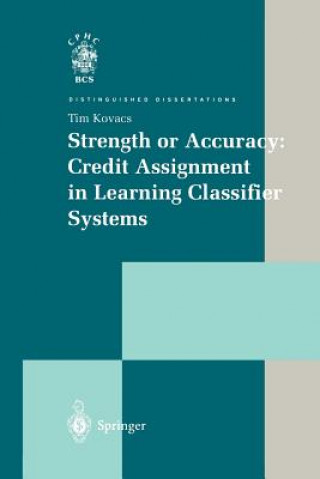
Kniha Strength or Accuracy: Credit Assignment in Learning Classifier Systems Tim Kovacs

Strength or Accuracy: Credit Assignment in Learning Classifier Systems

Autor: Tim Kovacs
Jazyk: Angličtina
Väzba: Brožovaná
Vydavateľ: Springer London Ltd
Dostupnosť: Skladom u dodávateľa
Odosielame za 5-8 dní
150.00
Classifier systems are an intriguing approach to a broad range of machine learning problems, based o...


Informácie o knihe

Autor
Jazyk
Angličtina
Väzba
Kniha - Brožovaná
Vydalo
2012
Stránok
307
EAN
9781447110583
ISBN
9781447110583
Enbook ID
05351833
Vydavateľ
Hmotnosť
470
Rozmery
156 x 234 x 17

Kompletný popis

Classifier systems are an intriguing approach to a broad range of machine learning problems, based on automated generation and evaluation of condi tion/action rules. Inreinforcement learning tasks they simultaneously address the two major problems of learning a policy and generalising over it (and re lated objects, such as value functions). Despite over 20 years of research, however, classifier systems have met with mixed success, for reasons which were often unclear. Finally, in 1995 Stewart Wilson claimed a long-awaited breakthrough with his XCS system, which differs from earlier classifier sys tems in a number of respects, the most significant of which is the way in which it calculates the value of rules for use by the rule generation system. Specifically, XCS (like most classifiersystems) employs a genetic algorithm for rule generation, and the way in whichit calculates rule fitness differsfrom earlier systems. Wilson described XCS as an accuracy-based classifiersystem and earlier systems as strength-based. The two differin that in strength-based systems the fitness of a rule is proportional to the return (reward/payoff) it receives, whereas in XCS it is a function of the accuracy with which return is predicted. The difference is thus one of credit assignment, that is, of how a rule's contribution to the system's performance is estimated. XCS is a Q learning system; in fact, it is a proper generalisation of tabular Q-learning, in which rules aggregate states and actions. In XCS, as in other Q-learners, Q-valuesare used to weightaction selection.

Mohlo by vás zaujímať

Spectator

RICHARD STEELE
41.28
120.91
94.95

Megabelt

Nick May
9.72

Generations

TWENGE JEAN M
15.72
11.00
228.65
74.11

Sailing Language

Elliott Dunlap Smith
8.35
219.80

Crohn's Disease

Cosimo Prantera
146.76

Zákazníci, ktorí si kúpili túto knihu, kúpili tiež

17.78

Seznam pro štěstí

Rachael Lippincottová
11.48

MAELSTROM

SIGRID RAUSING
20.83
24.47

Port-Royal. T. 3

Charles Augustin Sainte-Beuve
35.38
17.10

Pierrot lunaire

Arnold Schönberg
52.78