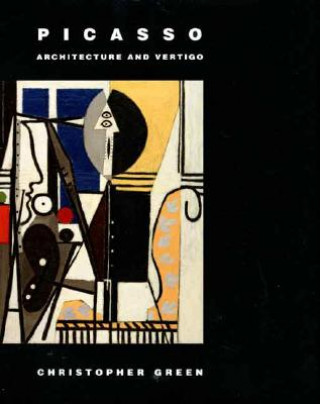
Kniha Picasso Christopher Green

Picasso

Architecture and Vertigo

Jazyk: Angličtina
Väzba: Pevná
Vydavateľ: Yale University Press
Dostupnosť: Skladom u dodávateľa v malom množstve
Odosielame za 9-15 dní
64.67
The starting point of this exciting new exploration of Picasso is not his life but his work, which i...
Informácie o knihe

Jazyk
Angličtina
Väzba
Kniha - Pevná
Vydalo
2006
Stránok
256
EAN
9780300104127
ISBN
030010412X
Enbook ID
04573705
Hmotnosť
1252
Rozmery
260 x 195 x 25

Kompletný popis

The starting point of this exciting new exploration of Picasso is not his life but his work, which is revealed as a series of interventions in the troubled history of early twentieth-century Europe. Christopher Green shows how these interventions are remarkable for the force with which they confront issues that remain vital and important for us today: race, cultural difference, modernity, sexuality and the discontents of civilization. The framework for Green's exploration is simple, yet enormously rich in its implications: the compulsion found in Picasso's work simultaneously to build architectures and to release himself from them. Architecture is used by Green to refer not merely to pictorial or sculptural structure, but to the architecture of knowledge and society: the structures of tradition, of racial, social and cultural distinction, of logic and of technology. He not only develops new ways of seeing the oscillation between order and disorder in Picasso's work, but moves outwards from it to reveal how it confronted and challenged the architectures of orthodoxy. The book opens with a completely fresh look at the Demoiselles d'Avignon in relation to late nineteenth- and early twentieth-century theories of racial difference, and closes with Picasso's confronting the question of race even more directly in 1933, on the threshold of the Holocaust. The intervening chapters focus on the artist's early Cubism, his metal guitars of 1912 and 1924, and the work he made alongside the Surrealists and their dissident opponents in contexts that open up the question of the avant-garde's relation to modern society, to national identity, to modernity and to the place of magic in a modern, demystified world. Each of these chapters, moreover, places the work in a different avant-garde context by bringing in one of the artists closest to Picasso in the period, thereby introducing new paths into the work not only of Picasso but also of the Douanier Rousseau, Georges Braque, Jacques Lipchitz and Joan Miro.

Mohlo by vás zaujímať

Picasso in Fontainebleau

UMLAND ANNE/FERRARI
44.45

Pablo Picasso

Jennifer Fandel
49.55
20.50

Sounds

Wassily Kandinsky
26.88

Pablo Picasso

Markus Müller
12.06

Picasso Prints

Stephen Coppel
40.82
23.35
8.72

Picasso

Rosalind Ormiston
11.47
41.11
44.25

Six Easy Pieces

Richard P. Feynman
12.45
38.07

Pablo Picasso

Sylvie Delpech
12.75

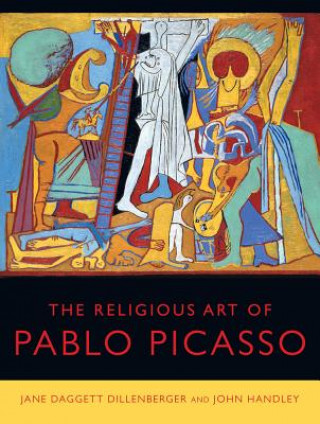
Religious Art of Pablo Picasso

Jane Daggett Dillenberger
42.29
14.71

High-Impact Tools for Teams

Stefano Mastrogiacomo
30.61

Picasso

Harald Theil
29.04

Creativity

Mihaly Csikszentmihalyi
14.32

Face Of Struggle

Seth Tobocman
14.42

Zákazníci, ktorí si kúpili túto knihu, kúpili tiež

19.91
20.11

Cubism

Rebecca Rabinow
52.50

Botticelli

Franz Zollner
35.81

Matisse

Volkmar Essers
14.81
19.42
75.95

Klimt

Gilles Néret
14.61

Freud

Sebastian Smee
14.61