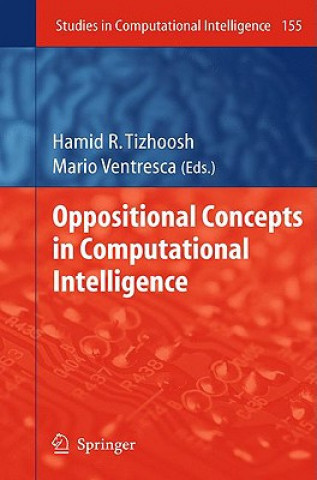
This volume is motivated in part by the observation that opposites permeate everything around us, in some form or another. Its study has attracted the attention of countless minds for at least 2500 years. However, due to the lack of an accepted mathematical formalism for opposition it has not been explicitly studied to any great length in fields outside of philosophy and logic. Despite the fact that we observe opposition everywhere in nature, our minds seem to divide the world into entities and opposite entities; indeed we use opposition everyday. We have become so accustomed to opposition that its existence is accepted, not usually questioned and its importance is constantly overlooked.§On the one hand, this volume is a fist attempt to bring together researchers who are inquiring into the complementary nature of systems and processes and, on the other hand, it provides some elementary components for a framework to establish a formalism for opposition-based computing. From a computational intelligence perspective, many successful opposition-based concepts have been in existence for a long time. It is not the authors intention to recast these existing methods, rather to elucidate that, while diverse, they all share the commonality of opposition - in one form or another, either implicitly or explicitly. Therefore they have attempted to provide rough guidelines to understand what makes concepts oppositional .This volume is motivated in part by the observation that opposites permeate everything around us, in some form or another. Its study has attracted the attention of countless minds for at least 2500 years. However, due to the lack of an accepted mathematical formalism for opposition it has not been explicitly studied to any great length in fields outside of philosophy and logic. Despite the fact that we observe opposition everywhere in nature, our minds seem to divide the world into entities and opposite entities; indeed we use opposition everyday. We have become so accustomed to opposition that its existence is accepted, not usually questioned and its importance is constantly overlooked.§On the one hand, this volume is a fist attempt to bring together researchers who are inquiring into the complementary nature of systems and processes and, on the other hand, it provides some elementary components for a framework to establish a formalism for opposition-based computing. From a computational intelligence perspective, many successful opposition-based concepts have been in existence for a long time. It is not the authors intention to recast these existing methods, rather to elucidate that, while diverse, they all share the commonality of opposition - in one form or another, either implicitly or explicitly. Therefore they have attempted to provide rough guidelines to understand what makes concepts "oppositional".