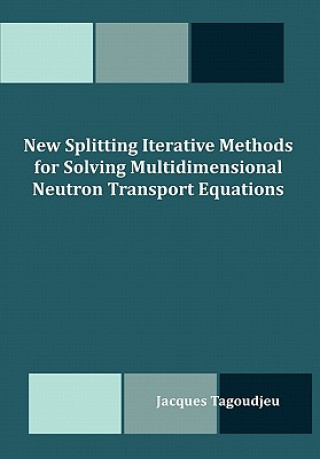
Kniha New Splitting Iterative Methods for Solving Multidimensional Neutron Transport Equations Jacques Tagoudjeu

New Splitting Iterative Methods for Solving Multidimensional Neutron Transport Equations

Jazyk: Angličtina
Väzba: Brožovaná
Vydavateľ: Dissertation.com
Dostupnosť: Skladom u dodávateľa
Odosielame za 14-21 dní
27.39
This thesis focuses on iterative methods for the treatment of the steady state neutron transport equ...


Informácie o knihe

Jazyk
Angličtina
Väzba
Kniha - Brožovaná
Vydalo
2011
Stránok
160
EAN
9781599423968
ISBN
9781599423968
Enbook ID
08765726
Vydavateľ
Hmotnosť
263
Rozmery
170 x 244 x 9

Kompletný popis

This thesis focuses on iterative methods for the treatment of the steady state neutron transport equation in slab geometry, bounded convex domain of Rn (n = 2,3) and in 1-D spherical geometry. We introduce a generic Alternate Direction Implicit (ADI)-like iterative method based on positive definite and m-accretive splitting (PAS) for linear operator equations with operators admitting such splitting. This method converges unconditionally and its SOR acceleration yields convergence results similar to those obtained in presence of finite dimensional systems with matrices possessing the Young property A. The proposed methods are illustrated by a numerical example in which an integro-differential problem of transport theory is considered. In the particular case where the positive definite part of the linear equation operator is self-adjoint, an upper bound for the contraction factor of the iterative method, which depends solely on the spectrum of the self-adjoint part is derived. As such, this method has been successfully applied to the neutron transport equation in slab and 2-D cartesian geometry and in 1-D spherical geometry. The self-adjoint and m-accretive splitting leads to a fixed point problem where the operator is a 2 by 2 matrix of operators. An infinite dimensional adaptation of minimal residual and preconditioned minimal residual algorithms using Gauss-Seidel, symmetric Gauss-Seidel and polynomial preconditioning are then applied to solve the matrix operator equation. Theoretical analysis shows that the methods converge unconditionally and upper bounds of the rate of residual decreasing which depend solely on the spectrum of the self-adjoint part of the operator are derived. The convergence of theses solvers is illustrated numerically on a sample neutron transport problem in 2-D geometry. Various test cases, including pure scattering and optically thick domains are considered.

Mohlo by vás zaujímať

10.95
49.21
9.58

Eliot the younger

BERNARD BARKER
19.86

Bad Teacher

Bad Teacher
10.27
66.63

Squirrel Rescue

Jennifer Keats Curtis
12.71

Cambridge Blue

Alison Bruce
10.46
15.65

Holiday Greetings

Leisure Arts
8.60

My Grandma Loves to Play

Winifred "Oyoko" Loving
16.92

Wheelie is Our Hero

Brenda Alexander
17.80
15.65

Zákazníci, ktorí si kúpili túto knihu, kúpili tiež

1979

Christian Kracht
11.44
8.78

Ishwar Kya Hai

J. Krishnamurti
14.38
186.71

Briefe

Ludwig Ritter Von K Chel
15.65

Solve et Coagula, 1 Audio-CD

Beasley/Morini/Accordone
16.92