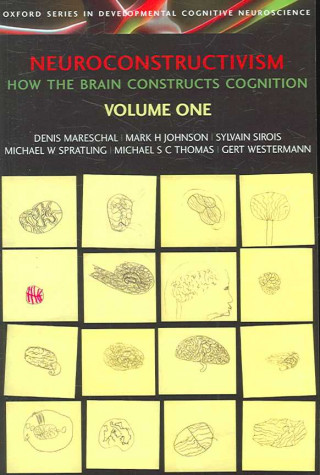
Kniha Neuroconstructivism - I & II Denis Mareschal

Neuroconstructivism - I & II

Jazyk: Angličtina
Väzba: Brožovaná
Dostupnosť: U vydavateľa na objednávku
Odosielame za 28-34 dní
133.39
What are the processes, from conception to adulthood, that enable a single cell to grow into a senti...


Informácie o knihe

Jazyk
Angličtina
Väzba
Kniha - Brožovaná
Vydalo
2007
Stránok
576
EAN
9780199214822
ISBN
0199214824
Enbook ID
04529543
Hmotnosť
896
Rozmery
156 x 232 x 29

Kompletný popis

What are the processes, from conception to adulthood, that enable a single cell to grow into a sentient adult? The processes that occur along the way are so complex that any attempt to understand development necessitates a multi-disciplinary approach, integrating data from cognitive studies, computational work, and neuroimaging - an approach till now seldom taken in the study of child development. Neuroconstructivism is a major new 2 volume publication that seeks to redress this balance, presenting an integrative new framework for considering development. In the first volume, the authors review up-to-to date findings from neurobiology, brain imaging, child development, computer and robotic modelling to consider why children's thinking develops the way it does. They propose a new synthesis of development that is based on 5 key principles found to operate at many levels of descriptions. They use these principles to explain what causes a number of key developmental phenomena, including infants' interacting with objects, early social cognitive interactions, and the causes of dyslexia. The "neuroconstructivist" framework also shows how developmental disorders do not arise from selective damage to normal cognitive systems, but instead arise from developmental processes that operate under atypical constraints. How these principles work is illustrated in several case studies ranging from perceptual to social and reading development. Finally, the authors use neuroimaging, behavioural analyses, computational simulations and robotic models to provide a way of understanding the mechanisms and processes that cause development to occur. Computer and robotic models provide concrete tools for investigating the processes and mechanisms involved in learning and development. Volume 2 illustrates the principles of 'Neuroconstructivist' development, with contributions from 9 different labs across the world. Each of the contributions illustrates how models play a central role in understanding development. The models presented include standard connectionist neural network models as well as multi-agent models. Also included are robotic models emphasizing the need to take embodiment and brain-system interactions seriously. A model of Autism and one of Specific Language Impairment also illustrate how atypical development can be understood in terms of the typical processes of development but operating under restricted conditions. This volume complements Volume 1 by providing concrete examples of how the 'Neuroconstructivist' principles can be grounded within a diverse range of domains, thereby shaping the research agenda in those domains.

Mohlo by vás zaujímať

22.01

Jefferson Davis

William E. Dodd
45.90

As a Decade Fades

Joshua Fields Millburn
15.33
17.88

Metus Principle

Brian A. Peters
15.33

Corporate Bankruptcy

William J Donoher
19.45

To Hell & Back

Lillie M Johnson
23.39

Analytic Tomography

Andrew Markoe
71.26

The Book of Memory

Mark Rowlands
13.75
11.00

Adrenal Glands

Dimitrios A. Linos
115.70

Italy and its Monarchy

Denis Mack Smith
55.34
162.98
24.37

Cave of Fontechevade

Philip G. Chase
48.26

Zákazníci, ktorí si kúpili túto knihu, kúpili tiež

Freidenker (Puzzle)

Christine B-B Müller
29.58

Tierra en Peligro

CARMEN MARTUL HERNANDEZ
20.83

Ralentir

Verbois
15.62

Cancionero

Gómez Manrique
24.57

El periodisme digital amb valor

Canovaca de la Fuente
23.29

Chvála pravdy

Torgny Lindgren
8.18
14.24

Hambre de cine

Israel de Francisco Sánchez
20.73

Der Niedergang Europas.

Walter Schilling
28.30
30.17

Kolumbus

Hansjoachim Andres
7.17
36.66