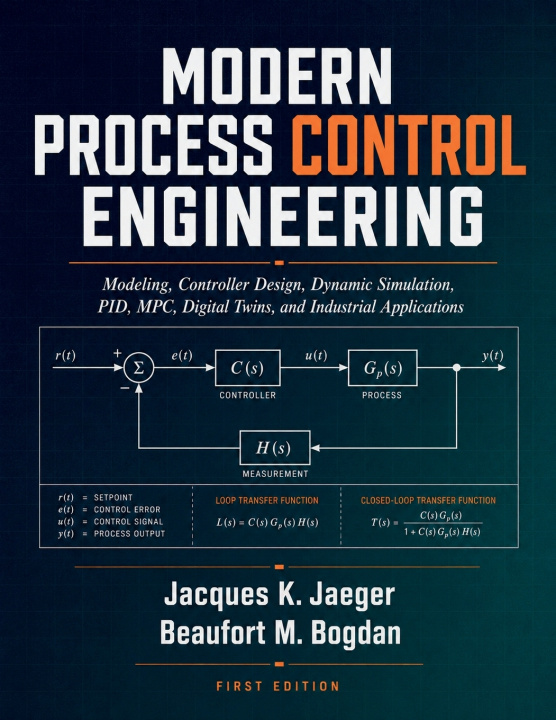
There are, in effect, two different books most people find when they go looking for process control instruction. One is a rigorous academic text that derives every transfer function and stability criterion but stops well short of a real control valve, a real safety-instrumented system, or a real distributed control system screen. The other is a field-oriented instrumentation reference that shows the hardware and day-to-day practice but treats the underlying mathematics as a black box to be trusted rather than understood. An engineer trying to tune an oscillating loop, defend a controller design in a hazard review, or judge whether an advanced-control project is worth its capital cost usually needs both books at once - and needs them to agree, which they often do not.
This engineering reference was built to close that gap in one continuously derived volume. It begins with first-principles process modeling and carries that same mathematical foundation forward through classical feedback theory, frequency-response and stability analysis, and advanced multivariable and predictive control, before connecting all of it to the instrumentation, control-system hardware, safety-instrumented-system design, and batch-control practice an operating facility actually runs on.
Inside, readers will:
- Build a working command of process modeling, linearization, Laplace-domain analysis, and empirical system identification, with every result derived rather than merely stated.
- Design and tune feedback controllers with classical and model-based methods, evaluate stability through both time-domain and frequency-domain criteria, and apply cascade, feedforward, ratio, override, and other advanced regulatory structures where a single loop is not enough.
- Analyze multivariable interaction and design model predictive controllers, from the underlying optimization problem through constrained, industrially deployed formulations.
- Connect control theory to the physical measurement chain, final control elements, and the control-system hardware and network architecture that carries a controller's decisions to the plant floor.
- Apply a structured, standards-based approach to process safety, alarm management, safety-instrumented-system design, and batch-process sequencing and record-keeping.
- Work through realistic industrial case studies and a capstone integrated control-retrofit project that ties modeling, tuning, safety, and economics together.
Every chapter pairs its theory with an objective-to-assessment map, classified practice problems, a data-analysis exercise built on synthetic companion datasets, and a laboratory or simulation project, so the book functions equally well as a course text, a self-study reference, or a working desk reference. Four appendices and a consolidated glossary and index extend its use as a long-term professional resource.
This book is written for practicing engineers who need a trustworthy reference for tuning, troubleshooting, and design decisions; upper-level engineering students meeting feedback control for the first time; and automation professionals evaluating advanced-control and safety-instrumented-system investments.
Get your copy and start building a working, connected understanding of process control engineering - from the governing balance equation to the safety-instrumented system that protects it.