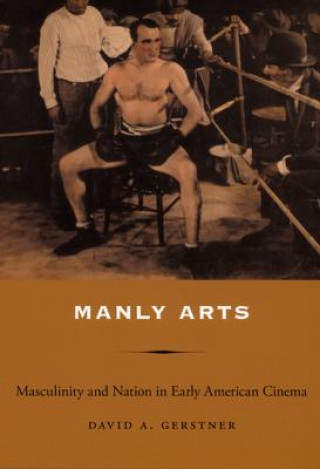
Kniha Manly Arts David A. Gerstner

Manly Arts

Masculinity and Nation in Early American Cinema

Jazyk: Angličtina
Väzba: Brožovaná
Vydavateľ: Duke University Press
Dostupnosť: Skladom u dodávateľa
Odosielame za 14-21 dní
35.02
In this innovative analysis of the interconnections between nation and aesthetics in the United Stat...

Informácie o knihe

Jazyk
Angličtina
Väzba
Kniha - Brožovaná
Vydalo
2006
Stránok
336
EAN
9780822337638
ISBN
0822337630
Enbook ID
04938354
Hmotnosť
478
Rozmery
157 x 236 x 20

Kompletný popis

In this innovative analysis of the interconnections between nation and aesthetics in the United States during the late nineteenth century and the early twentieth, David A. Gerstner reveals the crucial role of early cinema in consolidating a masculine ideal under American capitalism. Gerstner describes how cinema came to be considered the art form of the New World and how its experimental qualities infused artistic traditions (many associated with Europe--painting, literature, and even photography) with new life: brash, virile, American life. He argues that early filmmakers were as concerned with establishing cinema's standing in relation to other art forms as they were with storytelling. Focusing on the formal dimensions of early-twentieth-century films, he describes how filmmakers drew on European and American theatre, literature, and painting to forge a national aesthetic which they viewed as one that equated democracy with masculinity. Gerstner provides in-depth readings of several early American films, illuminating their connections to a wide range of artistic traditions and cultural developments, including dance, poetry, cubism, realism, romanticism, and urbanization. He shows how J. Stuart Blackton and Theodore Roosevelt developed The Battle Cry of Peace (1915) to disclose cinema's nationalist possibilities during the era of the new twentieth-century urban frontier; how Paul Strand and Charles Sheeler positioned a national avant-garde through the fusion of "American Cubism" and industrialization in their film, Manhatta (1921); and how Oscar Micheaux drew on slave narratives and other African American artistic traditions as he grappled with the ideological terms of African American and white American manhood in his movie Within Our Gates (1920). Turning to Vincente Minnelli's Cabin in the Sky (1943), Gerstner points to the emergence of an aesthetic of cultural excess that brought together white and African American cultural producers--many of them queer--and troubled the equation of national arts with masculinity.

Mohlo by vás zaujímať

"If the Workers Took a Notion"

Josiah Bartlett Lambert
40.30
29.05
92.06
99.59

Bonded

McCal Roberts
14.08
19.56

Zákazníci, ktorí si kúpili túto knihu, kúpili tiež

Glaukom, 2

W. Leydhecker
102.33

Rosenpersönlichkeiten

Maria Mail-Brandt
30.22