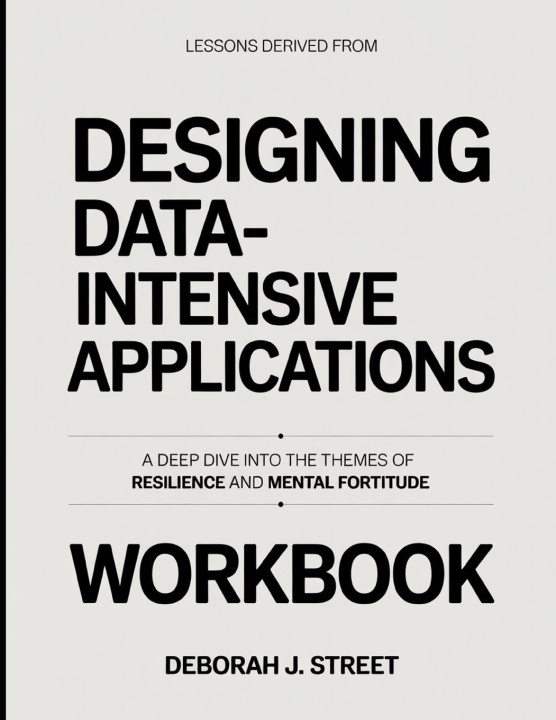
Kniha Lessons Derived From Designing Data-Intensive Applications Deborah J. Street

Lessons Derived From Designing Data-Intensive Applications

A Deep Dive into the Themes of Resilience and Mental Fortitude

Jazyk: Angličtina
Väzba: Brožovaná
Dostupnosť: Očakávané naskladnenie
Naskladnenie 04. 06. 2026
15.61
Lessons Derived From Designing Data-Intensive ApplicationsA deep technical and conceptual exploratio...

Informácie o knihe

Jazyk
Angličtina
Väzba
Kniha - Brožovaná
Vydalo
2026
Stránok
78
EAN
9798195329761
Enbook ID
52746461
Hmotnosť
205
Rozmery
216 x 280 x 4

Kompletný popis

Lessons Derived From Designing Data-Intensive Applications

  • A deep technical and conceptual exploration inspired by the principles in Designing Data-Intensive Applications, focusing on how modern systems handle scale, reliability, and complexity in the digital age
  • A structured breakdown of how data systems are built, maintained, and optimized, revealing the hidden architecture behind applications that power today's global digital infrastructure
  • Lessons on scalability, emphasizing how systems must be designed not just for current usage but for unpredictable future growth in users, data, and demand
  • A reflection on reliability, showing how resilient systems are engineered to continue functioning even when parts of the system fail or behave unexpectedly
  • Insights into maintainability, highlighting the importance of clean architecture, clear data models, and modular design to ensure long-term system health
  • Lessons on data modeling, showing how the structure of data directly influences performance, flexibility, and the ability to evolve applications over time
  • A deep dive into distributed systems, explaining how multiple machines work together to create the illusion of a single cohesive system
  • Lessons on consistency versus availability, exploring the trade-offs systems must make when balancing correctness of data with system uptime and responsiveness
  • Insights into fault tolerance, showing how systems anticipate failure as a normal condition rather than an exception to be avoided
  • A reflection on replication, demonstrating how copying data across systems improves durability, availability, and performance when properly managed
  • Lessons on partitioning (sharding), explaining how dividing data across multiple nodes enables systems to scale horizontally without collapsing under load
  • A focus on latency awareness, emphasizing how even small delays in data retrieval can significantly impact user experience and system efficiency
  • Insights into batch processing, showing how large datasets can be processed efficiently in groups rather than individual real-time operations
  • Lessons on stream processing, highlighting how real-time data handling enables immediate insights, alerts, and responsive application behavior
  • A reflection on system design trade-offs, showing that engineering is often about balancing competing priorities rather than achieving perfection in all areas
  • Lessons on observability, emphasizing the importance of logs, metrics, and tracing in understanding how systems behave in real-world conditions
  • A deep exploration of data integrity, showing how systems must ensure accuracy, consistency, and trustworthiness even in complex distributed environments
  • Insights into abstraction layers, explaining how complexity is managed by separating concerns into different levels of system design
  • A reflection on failure scenarios, emphasizing the importance of designing systems that expect, detect, and recover from errors gracefully
  • Lessons on throughput optimization, showing how performance is measured not just by speed but by the volume of data processed effectively over time
  • A focus on communication between services, highlighting how APIs, protocols, and messaging systems form the backbone of distributed architectures
  • Insights into consistency models, explaining how different systems define and enforce the correctness of data in varying ways
  • A final insight that designing data-intensive applications is not just about technology, but about understanding trade-offs, anticipating failure, and building systems that remain reliable, scalable, and meaningful in an ever-growing digital world