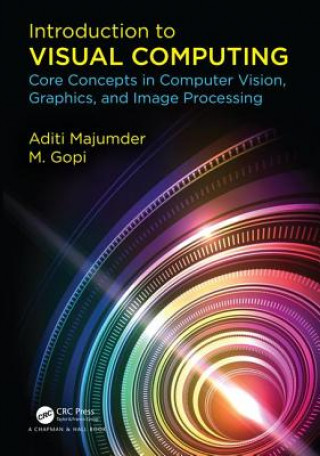
Introduction to Visual Computing: Core Concepts in Computer Vision, Graphics, and Image Processing covers the fundamental concepts of visual computing. Whereas past books have treated these concepts within the context of specific fields such as computer graphics, computer vision or image processing, this book offers a unified view of these core concepts, thereby providing a unified treatment of computational and mathematical methods for creating, capturing, analyzing and manipulating visual data (e.g. 2D images, 3D models). Fundamentals covered in the book include convolution, Fourier transform, filters, geometric transformations, epipolar geometry, 3D reconstruction, color and the image synthesis pipeline.
The book is organized in four parts. The first part provides an exposure to different kinds of visual data (e.g. 2D images, videos and 3D geometry) and the core mathematical techniques that are required for their processing (e.g. interpolation and linear regression.) The second part of the book on Image Based Visual Computing deals with several fundamental techniques to process 2D images (e.g. convolution, spectral analysis and feature detection) and corresponds to the low level retinal image processing that happens in the eye in the human visual system pathway.
The next part of the book on Geometric Visual Computing deals with the fundamental techniques used to combine the geometric information from multiple eyes creating a 3D interpretation of the object and world around us (e.g. transformations, projective and epipolar geometry, and 3D reconstruction). This corresponds to the higher level processing that happens in the brain combining information from both the eyes thereby helping us to navigate through the 3D world around us.
The last two parts of the book cover Radiometric Visual Computing and Visual Content Synthesis. These parts focus on the fundamental techniques for processing information arising from the interaction of light with objects around us, as well as the fundamentals of creating virtual computer generated worlds that mimic all the processing presented in the prior sections.
The book is written for a 16 week long semester course and can be used for both undergraduate and graduate teaching, as well as a reference for professionals.