Kniha Implantable Pressure Sensor Encapsulation for Ventricular Assist Device Control Christofer Hierold

Implantable Pressure Sensor Encapsulation for Ventricular Assist Device Control

Jazyk: Angličtina
Väzba: Brožovaná
Vydavateľ: Hartung-Gorre
Dostupnosť: Skladom u dodávateľa
Odosielame za 10-18 dní
38.43
Autonomous feedback controlled ventricular assists device (VAD) operation promises a plethora of ben...


Informácie o knihe

Jazyk
Angličtina
Väzba
Kniha - Brožovaná
Vydalo
2024
Stránok
192
EAN
9783866288348
ISBN
3866288344
Enbook ID
47066362
Vydavateľ
Hmotnosť
376
Rozmery
170 x 240 x 13

Kompletný popis

Autonomous feedback controlled ventricular assists device (VAD) operation promises a plethora of benefits such as increased patient safety, comfort, and reduced healthcare costs. Current generation VADs operate at static pump speeds due to the lack of available biocompatible, long-term stable pressure sensor systems.
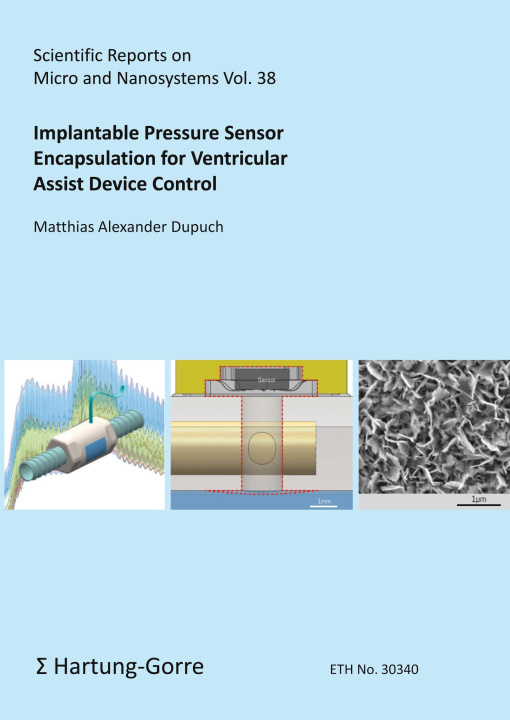
In this thesis, a pressure sensor encapsulation was developed and integrated in an inflow cannula for a VAD and in an implantable testing platform for animal trials. The encapsulation uses a media separating diaphragm embedded in a Parylene C coating. The approach is expanded to enable optimized diaphragm shapes, which allow significantly better control over the final device characteristics, especially the temperature cross sensitivity.
Furthermore, a production processes was developed to minimize assembly induced internal overpressure.
The produced capsules showed excellent pressure transmission of more than 99.7 % and a temperature cross sensitivity of less than 266 Pa from 35 °C to 42 °C for most capsules. However, a large temperature cross sensitivity was observed from room to body temperature in some capsules, adding relevant drift of 750 Pa (75 % quartile) after 42 days to the measurement.
The observed drift is related to the viscoelastic nature of the Parylene C diaphragm and the capsule-to-capsule variation is attributed to production process variations, which can be further optimized.
Systematic errors in the pressure transmission, temperature cross sensitivity (TCS), and drift were extracted and correction approaches for each were developed. This enabled the reduction of the pressure transmission error by 50 % by linear correction. A differential measurement approach reduced the temperature cross sensitivity to less than 70 Pa from 35 °C to 42 °C and drastically reduced the temperature induced drift to 300 Pa (75 % quartile) after a jump from room to body temperature. Half of all sensors even remained within a +- 100 Pa window in the same tim

Mohlo by vás zaujímať

106.26

Yukarism, Vol. 4

Chika Shiomi
6.28

Canada's Century

Robert John Barrett
37.15
7.07

Fusible Links

David Stone
13.65

Zákazníci, ktorí si kúpili túto knihu, kúpili tiež

7.07
23.29