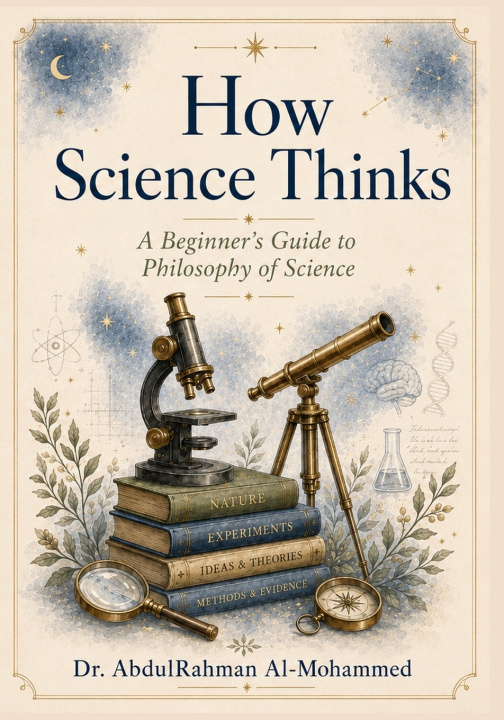
Science gives us knowledge but how does science itself work?
What makes a scientific theory different from a guess?
Can observation ever be completely objective?
Why do scientists disagree?
How does knowledge grow and change?
Why do scientific revolutions happen?
What responsibilities come with scientific discovery?
How are artificial intelligence and digital technology transforming research?
How Science Thinks explores the ideas behind scientific knowledge in clear, beginner-friendly language.
No previous knowledge of philosophy is required.
Through simple explanations, historical examples, real-world cases, and memorable visual metaphors, the book shows how scientists ask questions, evaluate evidence, form hypotheses, construct theories, test explanations, correct errors, and respond to uncertainty.
Rather than beginning with difficult terminology, each chapter builds understanding first and introduces philosophical concepts gradually.
Inside, you will discover:
- what philosophy of science studies and why it matters;
- why scientific facts require interpretation;
- how hypotheses, theories, models, and methods differ;
- how modern science developed from earlier traditions of knowledge;
- why scientific theories sometimes change or undergo revolutions;
- how Popper, Kuhn, Lakatos, Feyerabend, and other thinkers understood scientific progress;
- how science operates as a social institution;
- the difference between science, opinion, belief, ideology, and pseudoscience;
- why ethics, responsibility, and human values matter in research;
- how artificial intelligence, big data, and digital systems are reshaping scientific knowledge.
Written for students, lifelong learners, and curious readers, this book offers an accessible journey through one of the most important questions in human thought:
Not only what does science know but how does science know it?
No background in philosophy is required.
Only curiosity.