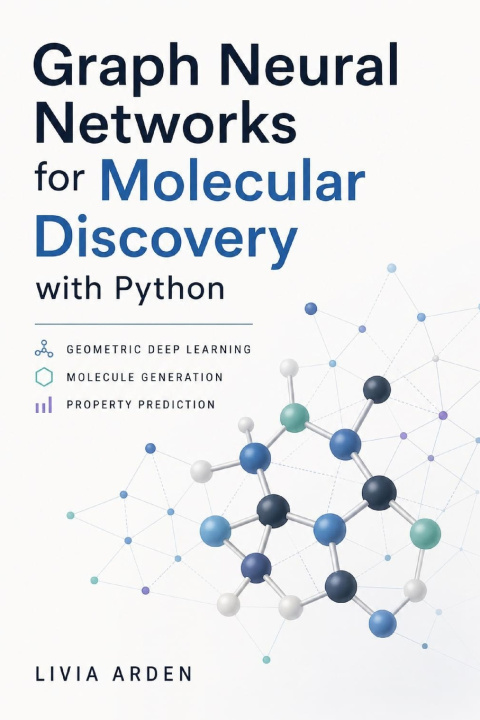
Kniha Graph Neural Networks for Molecular Discovery with Python Livia Arden

Graph Neural Networks for Molecular Discovery with Python

Geometric Deep Learning, Molecule Generation, and Property Prediction

Jazyk: Angličtina
Väzba: Brožovaná
Dostupnosť: Očakávané naskladnenie
Naskladnenie 29. 06. 2026
36.00
Reactive PublishingDiscover the future of molecular discovery with the power of Graph Neural Network...

Informácie o knihe

Jazyk
Angličtina
Väzba
Kniha - Brožovaná
Vydalo
2026
Stránok
538
EAN
9798184214115
Enbook ID
53016964
Hmotnosť
643
Rozmery
152 x 229 x 34

Kompletný popis

Reactive Publishing

Discover the future of molecular discovery with the power of Graph Neural Networks and Geometric Deep Learning.

In Graph Neural Networks for Molecular Discovery with Python, Livia Arden delivers a practical, hands-on guide to applying cutting-edge geometric deep learning techniques to one of the most exciting frontiers in science: accelerating the design and optimization of new molecules. Whether you're working in drug discovery, materials science, or chemical engineering, this book equips you with the tools to model molecular structures as graphs and extract powerful insights that traditional methods simply cannot match.

What You'll Learn
  • Master the fundamentals of Graph Neural Networks (GNNs) and how they naturally represent atoms, bonds, and molecular geometry.
  • Build and train sophisticated models for property prediction - from solubility and toxicity to bioactivity and quantum mechanical properties.
  • Explore molecule generation techniques, including variational autoencoders, generative adversarial networks, and diffusion models adapted for graphs.
  • Implement real-world workflows using Python libraries such as PyTorch Geometric, DGL, RDKit, and NetworkX.
  • Tackle challenges like molecular featurization, graph pooling, attention mechanisms, and scalable training on large chemical datasets.
  • Apply advanced topics including equivariant networks, 3D molecular modeling, and multi-task learning for accelerated virtual screening.
Hands-On and Production-Ready

Every concept is reinforced with clean, well-documented Python code examples that you can immediately adapt to your own research or projects. From loading SMILES strings and building molecular graphs to deploying predictive models and generating novel candidate compounds, this book bridges theory and practice with a strong emphasis on reproducibility and real-world impact.

Who This Book Is For
  • Data scientists and machine learning engineers eager to apply GNNs to scientific domains.
  • Computational chemists and researchers looking to modernize their discovery pipelines.
  • Graduate students and professionals in cheminformatics, bioinformatics, and materials informatics.
  • Anyone interested in the intersection of geometric deep learning and molecular science.