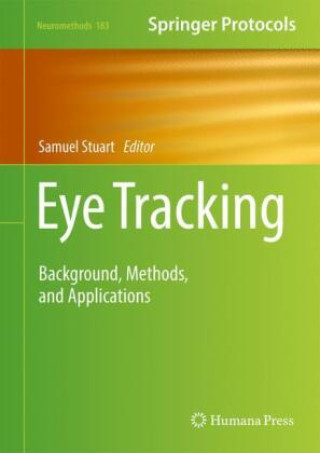
We make 3-5 eye movements per second, and these movements are crucial in helping us deal with the vast amounts of information we encounter in our everyday lives. In recent years, thanks to the development of eye tracking technology, there has been a growing interest in monitoring and measuring these movements, with a view to understanding how we attend to and process the visual information we encounter Eye tracking as a research tool is now more accessible than ever, and is growing in popularity amongst researchers from a whole host of different disciplines. Usability analysts, sports scientists, cognitive psychologists, reading researchers, psycholinguists, neurophysiologists, electrical engineers, and others, all have a vested interest in eye tracking for different reasons. The ability to record eye-movements has helped advance our science and led to technological innovations. However, the growth of eye tracking in recent years has also presented a variety of challenges - in particular the issue of how to design an eye-tracking experiment, and how to analyse the data. This book is a much needed comprehensive handbook of eye tracking methodology.
It describes how to evaluate and acquire an eye-tracker, how to plan and design an eye tracking study, and how to record and analyse eye-movement data. Besides technical details and theory, the heart of this book revolves around practicality - how raw data samples are converted into fixations and saccades using event detection algorithms, how the different representations of eye movement data are calculated using AOIs, heat maps and scanpaths, and how all the measures of eye movements relate to these processes. Part I presents the technology and skills needed to perform high-quality research with eye-trackers. Part II covers the predominant methods applied to the data which eye-trackers record. These include the parsing of raw sample data into oculomotor events, and how to calculate other representations of eye movements such as heat maps and transition matrices. Part III gives a comprehensive outline of the measures which can be calculated using the events and representations described in Part II. This is a taxonomy of the measures available to eye-tracking researchers, sorted by type of movement of the eyes and type of analysis.
For anyone in the sciences considering conducting research involving eye-tracking, this book will be an essential reference work.