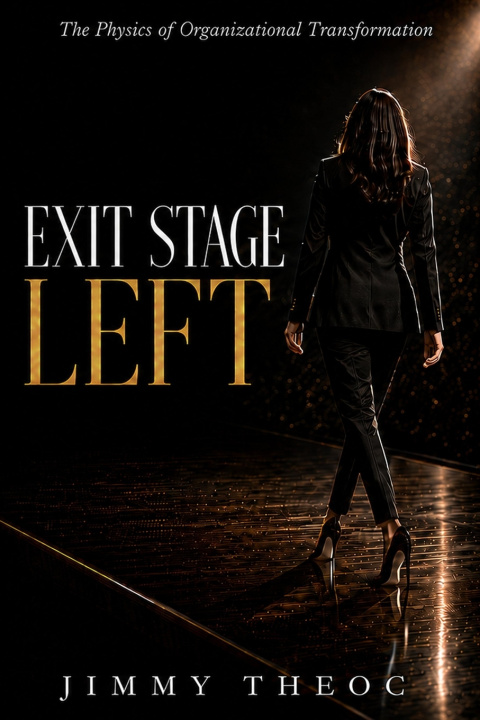
Every organization carries weight. Not just the weight of assets, debt, processes, and history, but the accumulated force of every decision that has made the company what it is. Leaders feel that weight when the obvious move becomes difficult to execute. Boards feel it when strategy stalls. Employees feel it when delay finally reaches the people asked to absorb its cost.
Exit Stage Left: The Physics of Organizational Transformation introduces Organizational Physics, a practical framework for measuring whether transformation is still possible before capital, time, and trust run out. Through the story of Sandra Wilcox, a turnaround CEO racing to save the eighty-one-year-old luxury brand Harlow and Stone, and Eleanor Stone, the founder who understood the company's physics by instinct, Jimmy Theoc shows how leaders can calculate what change really requires.
This book moves beyond slogans about culture and change management. It gives leaders a way to think in terms of mass, acceleration, friction, force, capital, runway, and courage. It asks hard questions that every executive, founder, operator, and board member eventually faces. What does the organization weigh? How fast must performance improve? How much resistance will the system create? How much capital is required? And when is the wiser decision not to push harder, but to exit before the stage goes dark?
Blending business narrative with analytical tools, Exit Stage Left examines the anatomy of decline, the burden of leadership decisions, the structure of corporate governance, and the difference between transformation that creates momentum and transformation that becomes theater. The book draws lessons from organizations that failed to move in time, companies that found a second turn, and leaders who understood that survival depends on more than vision. It makes the invisible forces of change visible and discussable.
At its core, Exit Stage Left is a guide for leaders facing systems that resist the change they need most. It is for anyone responsible for making decisions when legacy, debt, culture, and time are pressing in from every side.
Transformation is not only about deciding to change. It is about knowing whether the organization still has enough force to move.