Most books on electric motors teach either the mathematics of machine behavior or the wiring of a control panel - rarely both at the depth a modern plant demands.
If you can program a controller but cannot derive the torque-speed curve of the motor it commands, or you know induction-machine theory but have never sized an overload or coordinated protection, you are working with half the picture. That gap becomes guesswork on the plant floor: oversized equipment, nuisance trips, and designs that pass on paper but struggle in service.
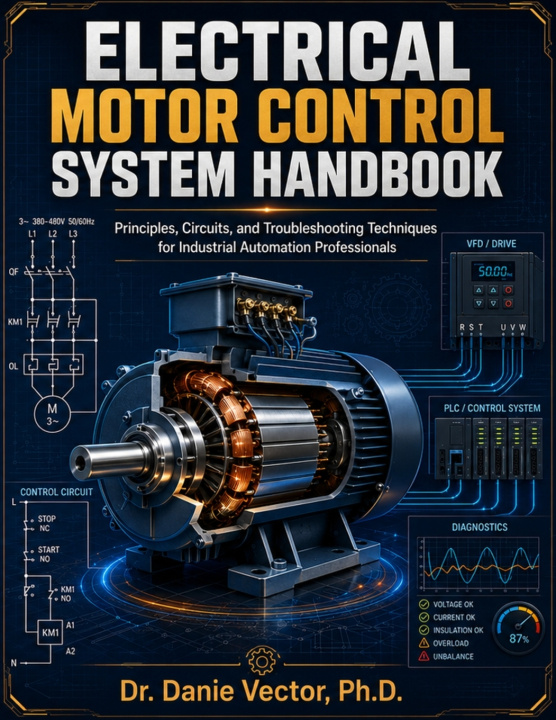
This handbook closes the gap. It develops the electrical and machine-theory foundations from first principles, then carries them straight into the equipment, circuits, calculations, and troubleshooting used to build and maintain real industrial motor control systems.
Inside, you will:
- Follow every result from fundamentals - three-phase power, induction and DC machines, and drive operation - derived step by step.
- Calculate what drives real decisions: power factor and correction, slip, torque, motor current, and voltage drop.
- Design and read control logic - two-wire, three-wire, ladder diagrams, and programmable control.
- Select, size, and commission variable-frequency drives and reduced-voltage starters, matching the method to the load.
- Size overloads and coordinate protection so faults clear where they should.
- Lay out motor control centers and panels that are safe and serviceable, and apply energy-efficient practices.
- Reinforce every chapter with worked examples, practice problems and answers, and key-equation summaries.
Key topics include three-phase power; AC induction and DC machines; manual, magnetic, reduced-voltage, and variable-frequency starting and speed control; motor protection and coordination; control circuit and ladder-logic design; programmable logic controllers; sensors and feedback; motor control center and panel design; energy efficiency; and servo and stepper systems.
It is written for upper-level electrical and mechatronics students, for practicing plant, electrical, and controls engineers who need one rigorous theory-plus-application reference, and for advanced technicians who want the engineering behind the equipment they maintain.
Take the next step toward mastering motor control from the machine to the panel - add this comprehensive handbook to your library and build the complete, connected understanding that modern automation work demands.