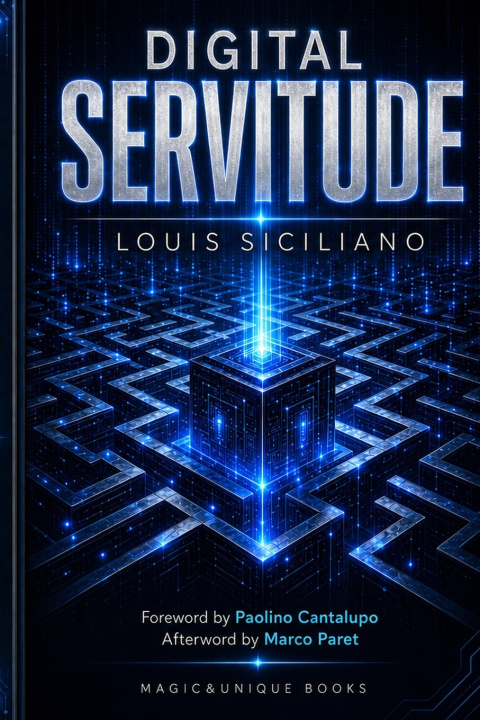
Attention has become the most fiercely contested territory of our time.
Every digital gesture leaves a trace. Every pause can be interrupted. Every desire can be anticipated, directed, transformed into behaviour. Platforms observe, learn, predict. Meanwhile, the mind loses continuity, the body adapts to interruption, and our relationship with the world is increasingly mediated by systems designed to keep us engaged.
Louis Siciliano examines the new architecture of digital power through a radical question: what happens to a human being when attention is continuously shaped from outside?
What emerges is an inquiry that brings together neurobiology, philosophy, education, the surveillance economy, and everyday life. Dopamine, memory, short-form video, childhood, school, the body, loneliness, algorithms, and democracy form a single landscape: that of a civilisation that has turned mental time into a resource to be extracted.
At its centre stands a decisive concept: cognitive dignity. The right to preserve a mind capable of duration, depth, silence, and choice.
The question concerns us all. Parents, teachers, adolescents, educators, citizens. Because the future of freedom may depend on something we have regarded for far too long as a mere mental faculty.
Whoever directs attention takes part in shaping reality.
And reclaiming it means becoming present again.