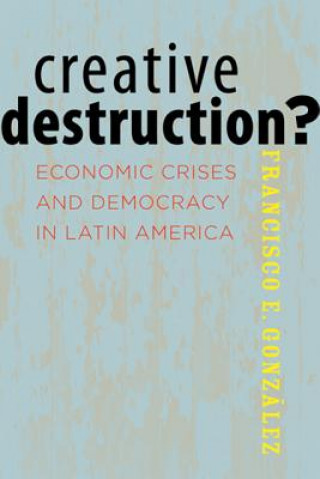
Kniha Creative Destruction? Francisco Gonzalez

Creative Destruction?

Jazyk: Angličtina
Väzba: Brožovaná
Dostupnosť: Skladom u dodávateľa v malom množstve
Odosielame za 11-15 dní
51.26
Throughout the twentieth century, financial shocks toppled democratic and authoritarian regimes acro...

Informácie o knihe

Jazyk
Angličtina
Väzba
Kniha - Brožovaná
Vydalo
2012
Stránok
296
EAN
9781421405421
ISBN
1421405423
Enbook ID
04474193
Hmotnosť
400
Rozmery
228 x 151 x 19

Kompletný popis

Throughout the twentieth century, financial shocks toppled democratic and authoritarian regimes across Latin America. But things began to change in the 1980s. This volume explains why this was the case in Argentina, Chile, and Uruguay. Taking a comparative historical approach, Francisco E. Gonzalez looks at how the Great Depression, Latin America's 1980s debt crisis, and the emerging markets' meltdowns of the late 1990s and early 2000s affected the governments of these three Southern Cone states. He finds that democratic or not, each nation's governing regime gained stability in the 1980s from a combination of changes in the structure and functioning of national and international institutions, material interests, political ideologies, and economic paradigms and policies. Underlying these changes was a growing ease in the exchange of ideas. As the world's balance of power transitioned from trilateral to bipolar to unipolar, international institutions such as the World Bank and the International Monetary Fund increased crisis interventions that backstopped economic freefalls and strengthened incumbents. Urban-based populations with relatively high per capita income grew and exercised their preference for the stability and prosperity they found as a class under democratic rule. These and other factors combined to substantially increase the cost of military takeovers, leading to fewer coups and an atmosphere friendlier toward domestic and foreign capital investment. Gonzalez argues that this confluence created a pro-democracy bias - which was present even in Augusto Pinochet's Chile - that not only aided the states' ability to manage economic and political crises but also lessened the political, social, and monetary barriers to maintaining or even establishing democratic governance. With a concluding chapter on the impact of the Great Recession in other Latin American states, Eastern Europe, and East Asia, "Creative Destruction?" lends insight into the survival of democratic and authoritarian regimes during times of extreme financial instability. Scholars and students of Latin America, political economy, and democratization studies will find Gonzalez's arguments engaging and the framework he built for this study especially useful in their own work.

Mohlo by vás zaujímať

10.28
13.32

Midnight Lock

Jeffery Deaver
8.42
14.30

Social Media Analytics

Sandeep Kautish
25.08
31.65
17.34
17.24
44.39

On Obama

Paul C. Taylor
209.36

Discombobulation

Wayne Rudolph Davidson
42.53
45.18

In Search of Solutions

Michele Weiner-Davis
22.24
22.93
130.26

Cain/Westbrook

Beverly Koester
24.30

Zákazníci, ktorí si kúpili túto knihu, kúpili tiež

28.22

Deutsche Wirtschaftsgeschichte.

Karl Theodor von Inama-Sternegg
118.50

Harzreise

Heinrich Heine
13.13