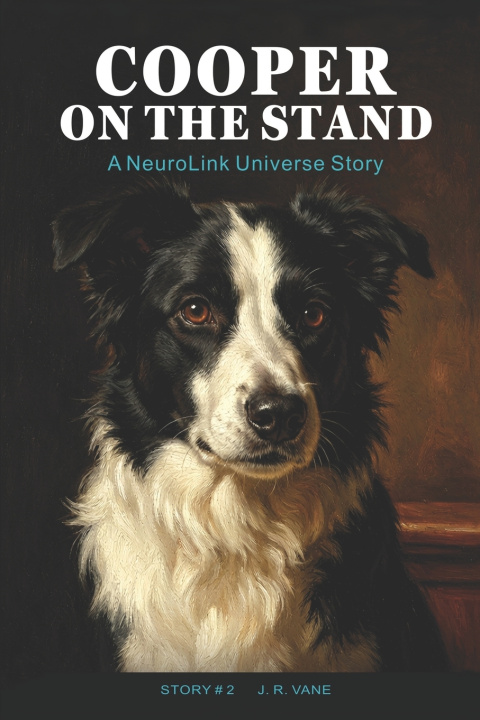
In near-future Portland, Cooper - a five-year-old border collie with an SL-2 neural interface implant - has spent six months with human-level intelligence and language. She has spent those six months processing five years of memories: the quiet years when the family was whole, the slow deterioration of Linda and Greg's marriage, Greg's affair with a woman named Nicole, and his secret transfers of $47,200 into a hidden bank account.
Now the divorce has reached court, and Greg's lawyer Mitchell Harwood has filed a motion no American court has ever granted: he wants Cooper to testify.
On November 18, 2035, Cooper walks into Multnomah County Circuit Court. She takes the witness stand and describes the marriage's death with border collie precision - timestamps, cortisol percentages, the exact scatter radius of a shattered coffee mug. She doesn't help either side. Greg's lawyer Harwood tries to steer her toward proving Linda unstable; Linda's lawyer Reyes tries to use her to expose Greg's secret account. Cooper answers both with equal honesty, because truth - as she tells the court - doesn't pick sides.
Then Judge Patricia Okonkwo asks the question that will create legal precedent: Does Cooper want to be allocated to Linda or Greg?
Cooper refuses. She identifies the paradox at the heart of the case: if the court accepts her testimony, it has acknowledged she has judgment. If she has judgment, asking her to choose who "owns" her is an insult to that judgment. You cannot, she tells the court, admit that she is a person one hour and treat her as an object the next.
The judge's ruling - that Cooper is not allocated to either party, but follows the children to their grandmother's home - becomes the first legal precedent in American jurisprudence acknowledging that a Granted's cognitive abilities may transcend the legal framework of property.
A standalone courtroom drama from the NeuroLink Universe - a series about what happens when the animals we love can finally speak.