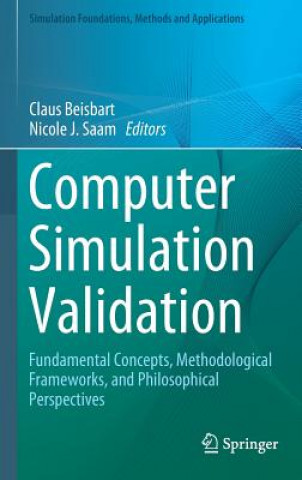
Kniha Computer Simulation Validation Claus Beisbart

Computer Simulation Validation

Fundamental Concepts, Methodological Frameworks, and Philosophical Perspectives

Jazyk: Angličtina
Väzba: Pevná
Dostupnosť: Skladom u dodávateľa
Odosielame za 10-13 dní
229.64
Computer simulation is a new method that has become a standard technique in many natural and social...


Informácie o knihe

Jazyk
Angličtina
Väzba
Kniha - Pevná
Vydalo
2019
Stránok
1074
EAN
9783319707655
ISBN
3319707655
Enbook ID
18344658
Hmotnosť
1771
Rozmery
155 x 235 x 63

Kompletný popis

Computer simulation is a new method that has become a standard technique in many natural and social sciences. Validation comprises the efforts to show that computer simulations provide faithful representations of their target systems. Thus far, validation has much been neglected in the literature, and working scientists have expressed uncertainty about how they should build trust their simulation results. In practice, validation is often neglected completely or only done in a sloppy way. As a consequence, some purported results from computer simulations have later turned out to rest on numerical artefacts. In the absence of clear guidelines, the method of computer simulation, successful as it might seem, is not yet fully developed. To validate the results of simulations is to make a case for them, to argue that they are realistic, or to enhance their plausibility. Put this way, validation seems fairly straightforward, but, as a matter of fact, it is not well-understood and even controversial from a theoretical point of view. Already the very term "validation" is a matter of debate, as the term is misleading because a simulation cannot be shown to be true or valid except in trivial cases. It is further discussed how validation is related to what people call verification, i.e. the attempt to show that a simulation reliably traces the predictions of a model. Another key question is how one can determine the overall confidence of simulation results if a number of tests have been carried out. Addressing this dissatisfying understanding of validation, this book presents a methodological and philosophical discussion about the validation of computer simulation and of its techniques. The work covers the basic notions and ideas underlying validation (e.g. the notions of validation, verification and error, are clarified), conceptualizes the concept of validation in frameworks from the philosophy of science (e.g. in Bayesian epistemology), and presents practical guidelines and important techniques for validation (e.g. introducing the quantification of uncertainties). The volume also reviews the challenges of validation (e.g. considering the sparseness of data) and offers examples of best practice. This is achieved through an interdisciplinary collection of authors that includes computer scientists (who discuss the most important approaches to validation), mathematicians and statisticians (who present mathematical techniques for validation), and working scientists from various fields (who present best practice examples of validation and reflect about related challenges).

Mohlo by vás zaujímať

Italianissimo

Louise Fili
16.69

Hu Ming

Hu Ming
41.54
8.63

CODE OF FEDERAL REGULATIONS TI

National Archives and Records Administra
54.31

Turbulent Times

Stephen G. Yanoff
31.13
7.06

Time Flies

Christina G. Rossetti
19.93
167.76

Free Bastards

Jonathan French
9.42
45.27
139.66
47.63

Yoga

Helga Polet-Kittler
9.42

Ottoman Tragedy

Gabriel Piterberg
91.04

Zákazníci, ktorí si kúpili túto knihu, kúpili tiež

Le Syndrome d'imposture

Elisabeth Cadoche
11.78

Paracelsus

Pirmin Meier
42.13

Alten Leutchen

Helene Böhlau
7.95

Am Pflug

Leopold Kompert
15.71

Religion

Patrick Haumont Parisi
11.29
23.07

Gantz 11

Hiroja Oku
7.96

Cofiant Y Parch, Richard Owen, Y Diwygiwr

William Pritchard (of Pentraeth)
23.96

Vivienne Westwood

Vivienne Westwood
15.71