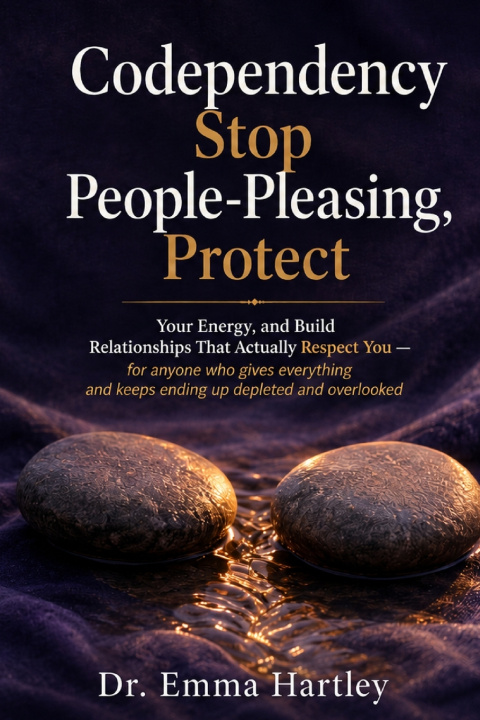
You Love Them. You Just Can't Tell Where They End and You Begin.
You care deeply about the people in your life.
You show up when they need you.
You solve problems, calm conflicts, anticipate needs, and carry emotional burdens that were never yours to carry.
From the outside, it looks like kindness.
Inside, it often feels like exhaustion.
If someone else's mood determines your peace, if saying no fills you with guilt, or if your sense of worth depends on being needed, this book begins with a different truth:
This isn't simply generosity.
It may be codependency.
Codependency is a practical, science-based guide for adults who want to understand the psychological mechanisms behind chronic self-sacrifice before trying to change it.
Rather than reducing codependency to "being too nice," this book explores how early relationships, attachment patterns, trauma, and the nervous system can shape a life organized around other people's emotions instead of your own.
Drawing on attachment theory, neuroscience, family systems, trauma psychology, and evidence-based therapeutic approaches, you'll learn why these patterns develop, why they become so difficult to break, and how genuine recovery becomes possible.
Inside you'll discover:
• The core mechanism that drives codependency and why it often begins long before adulthood
• How childhood experiences shape your beliefs about love, safety, responsibility, and self-worth
• The connection between attachment styles, people-pleasing, and emotional overfunctioning
• Why guilt feels overwhelming when you try to prioritize your own needs
• The role of shame, fear of abandonment, and conflict avoidance in maintaining unhealthy relationships
• How your nervous system becomes conditioned to monitor and manage other people's emotions
• The difference between healthy compassion and self-abandonment
• Practical strategies for setting boundaries without guilt or hostility
• How to rebuild a stable sense of identity that doesn't depend on being needed
• Ways to recognize emotionally healthy relationships and break repetitive relational patterns
• Daily exercises that strengthen self-awareness, emotional regulation, and self-trust
• A step-by-step framework for creating relationships built on mutual respect instead of emotional dependence
This isn't a book about loving people less.
It isn't about becoming distant, selfish, or emotionally unavailable.
It's about discovering that genuine love doesn't require abandoning yourself.
Healthy relationships allow both people to exist fully.
They don't require one person to disappear so the other can feel secure.
Recovery isn't about becoming someone different.
It's about remembering who you were before you learned that love had to be earned through self-sacrifice.
Because your value has never depended on how much of yourself you give away.
You deserve relationships where care flows in both directions.
Where your needs matter.
Where your voice matters.
Where you matter.
Healing isn't becoming someone new.
It's coming home to who you've always been.