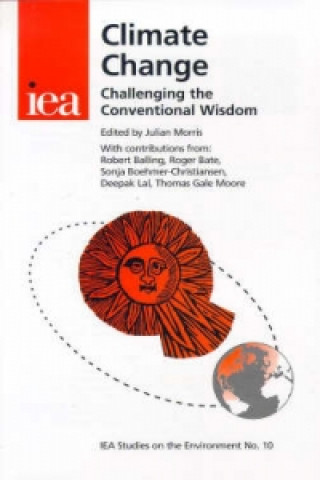
Kniha Climate Change Julian Morriss

Climate Change

Challenging the Conventional Wisdom

Jazyk: Angličtina
Väzba: Brožovaná
Dostupnosť: Skladom u dodávateľa
Odosielame za 10-18 dní
22.32
The world's climate is in constant flux: on time-scales from days to millennia, global and regional...

Informácie o knihe

Jazyk
Angličtina
Väzba
Kniha - Brožovaná
Vydalo
1997
Stránok
112
EAN
9780255364430
ISBN
0255364431
Enbook ID
04560037
Hmotnosť
152
Rozmery
137 x 219 x 9

Kompletný popis

The world's climate is in constant flux: on time-scales from days to millennia, global and regional temperature, wind and rainfall patterns are changing. Over periods of decades and centuries, the most significant factor affecting climate appears to be changes in the output of the sun. Man's emissions of 'greenhouse gases' (GHGs) also play a role in altering climate. However, estimates suggest that only 30 to 40 per cent of the warming seen over the past century was caused by GHGs. Predictions made by the Intergovernmental Panel on Climate Change (IPCC) assume that most of the warming of the past century was caused by man's emissions and therefore overestimate the likely effect of future emissions. Better estimates suggest that if CO2 concentrations double, global-mean temperatures would rise by about 1.3 degrees centigrade with an upper limit of 2 degrees centigrade. Estimates by some of the world's most respected climate scientists suggest that even if a warming of 2 degrees centigrade does occur the impact on humankind will not be catastrophic; indeed agricultural productivity is likely to increase in many parts of the world, due to longer growing seasons and increases in uptake of CO2. IPCC lead authors have exaggerated the likely impacts of climate change in order to heighten public perception of the issue and thereby encourage governments to spend more on climate research. Between 1990 and 1995, annual US Government spending on climate research rose from $600m to $1.8bn. Estimates suggest that the cost of reducing CO2 emissions to 1990 levels by 2010 could be around 1 per cent of global output. Even assuming costs were only half that, the result would be less investment in the development of new technologies and considerable industrial downsizing, with consequent job losses. Furthermore, if significant natural climate change does occur in the next century - as it has over the past 100 years - then the cost of imposing limits on emissions of carbon dioxide and other trace gases might be even greater. Whether this natural climate variation causes the Earth to warm or to cool, the consequence of emission limits would be that fewer resources would be available for taking adaptive action (such as installing air conditioning units or heaters) Given the uncertainty about climate change, the precautionary principle implies that we should improve our understanding of the world's climate and do what we can to ensure that we are able to adapt most effectively. This means collecting better data, encouraging scientists to develop and test competing theories about the causes and consequences of climate change, freeing up the world's markets, and eliminating subsidies.

Mohlo by vás zaujímať

92.35
21.15
26.24

Approaching the Divine

MARGARET LOE REIMER
33.00

Prince Boofhead Syndrome

Michael Carr-Gregg
21.24

Art of History

Lisa Gail Collins
43.87

Chiropractic

George Magner
23.01
128.98

Gangster Film

Ron Wilson
23.59

Singing Sherlock

Shirley Court
56.40
27.61

Performance and Media

Sarah Bay-Cheng
27.90

Zákazníci, ktorí si kúpili túto knihu, kúpili tiež

16.35