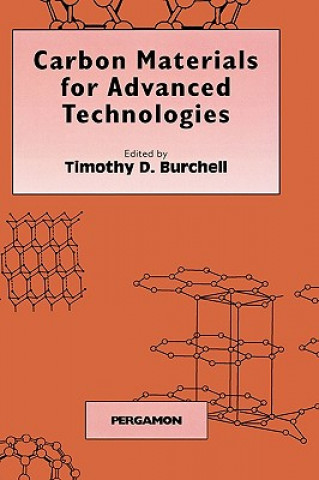
The inspiration for this book came from an American Carbon Society Workshop entitled 'Carbon Materials for Advanced Technologies' which was hosted by the Oak Ridge National Laboratory in 1994. Chapter 1 contains a review of carbon materials, and emphasizes the structure and chemical bonding in the various forms of carbon, including the four allotropes diamond, graphite, carbynes, and the fullerenes. In addition, amorphous carbon and diamond films, carbon nanoparticles, and engineered carbons are discussed. The most recently discovered allotrope of carbon, i.e., the fullerenes, along with carbon nanotubes, are more fully discussed in Chapter 2, where their structure-property relations are reviewed in the context of advanced technologies for carbon based materials. The synthesis, structure, and properties of the fullerenes and nanotubes, and modification of the structure and properties through doping, are also reviewed. Potential applications of this new family of carbon materials are considered. The manufacture and applications of adsorbent carbon fibers are discussed in Chapter 3.
The manufacture, structure and properties of high performance fibers are reviewed in Chapter 4, and the manufacture and properties of vapor grown fibers and their composites are reported in Chapter 5. The properties and applications of novel low density composites developed at Oak Ridge National Laboratory are reported in Chapter 6. Coal is an important source of energy and an abundant source of carbon. The production of engineering carbons and graphite from coal via a solvent extraction route is described in Chapter 7. Applications of activated carbons are discussed in Chapters 8-10, including their use in the automotive arena as evaporative loss emission traps (Chapter 8), and in vehicle natural gas storage tanks (Chapter 9). The application of activated carbons in adsorption heat pumps and refrigerators is discussed in Chapter 10. Chapter 11 reports the use of carbon materials in the fast growing consumer electronics application of lithium-ion batteries. The role of carbon materials in nuclear systems is discussed in Chapters 12 and 13, where fusion device and fission reactor applications, respectively, are reviewed.
In Chapter 12 the major technological issues for the utilization of carbon as a plasma facing material are discussed in the context of current and future fusion tokamak devices. The essential design features of graphite moderated reactors, (including gas-, water- and molten salt-cooled systems) are reviewed in Chapter 13, and reactor environmental effects such as radiation damage and radiolytic corrosion are discussed. The fracture behaviour of graphite is discussed in qualitative and quantitative terms in Chapter 14. The applications of Linear Elastic Fracture Mechanics and Elastic-Plastic Fracture Mechanics to graphite are reviewed and a study of the role of small flaws in nuclear graphites is reported.