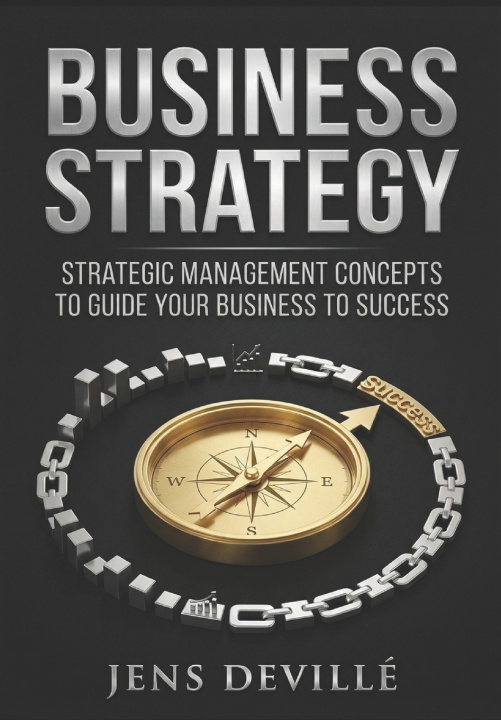
Business strategy is not about predicting the future. It is about understanding the forces that shape it and making informed decisions that create sustainable value. In a world of technological disruption, global competition, changing customer expectations, and economic uncertainty, organizations need a clear strategy and the ability to turn ambition into measurable results.
This book provides a practical and comprehensive introduction to business strategy and strategic management. It explores the concepts, frameworks, and methodologies that help organizations define direction, build competitive advantage, identify growth opportunities, and successfully execute their plans.
The journey begins with the foundations of strategic analysis. Readers learn how to assess internal strengths and weaknesses, evaluate opportunities and threats, and understand the competitive forces that influence business performance. Key strategic tools are presented in a clear and accessible way, providing a solid basis for effective decision-making.
The book then examines competitive advantage and value creation. Why do some organizations consistently outperform others? How can resources, capabilities, innovation, and strategic positioning be transformed into lasting success? Through practical insights and proven frameworks, readers gain a deeper understanding of the drivers of long-term performance.
Growth is another central theme. Organizations face important choices regarding market expansion, diversification, innovation, internationalization, partnerships, mergers, and acquisitions. Each option presents opportunities as well as risks. This book helps readers evaluate strategic alternatives and select approaches that support long-term objectives.
In today's rapidly changing environment, organizations must also be adaptable. Technological innovation, globalization, economic developments, regulatory changes, and evolving stakeholder expectations constantly reshape the business landscape. Understanding these trends helps organizations anticipate challenges and identify new opportunities.
Special attention is given to innovation and strategic agility. Readers are introduced to concepts such as strategic foresight, scenario planning, business model innovation, and design thinking. These tools help decision-makers prepare for uncertainty and respond effectively to changing market conditions.
A strategy is only valuable if it can be executed successfully. Many organizations struggle to transform strategic plans into results. The book therefore explores strategy implementation in depth, covering organizational alignment, governance, leadership, culture, performance management, and change management. It demonstrates how organizations can bridge the gap between strategic intent and operational execution.
The human dimension of strategy is equally important. Long-term success requires balancing the interests of customers, employees, shareholders, partners, regulators, and society. By addressing stakeholder management and responsible value creation, the book highlights how sustainable success is built through trust, resilience, and strong relationships.
Suitable for executives, managers, entrepreneurs, consultants, analysts, and students, this book serves both as a learning resource and a practical reference. Whether developing a strategic plan, evaluating business opportunities, responding to competitive pressures, or leading transformation initiatives, readers will gain valuable insights and practical tools that can be applied immediately.
By connecting strategic analysis, competitive advantage, growth, innovation, stakeholder management, and execution into a coherent framework, Business Strategy provides a roadmap for understanding how successful organizations compete, evolve, and create lasting value in an increasingly complex world.