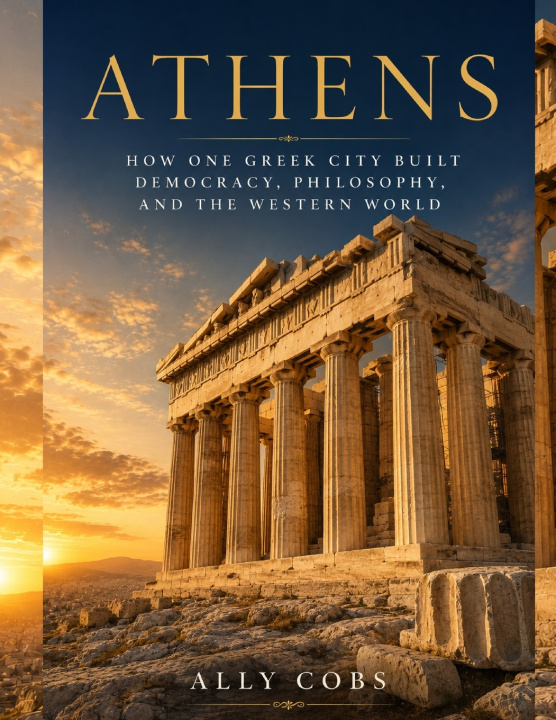
Twenty five centuries ago, a rocky hill above a crowded harbor became the setting for an experiment no city had ever attempted at scale: government by its own citizens.
Athens rises from these pages not as a distant monument, but as a living, working city, one where philosophers argued in the marketplace, farmers voted between planting seasons, and a woman named Phryne stood trial for her life over a statue rumored to bear her likeness. This book follows Athens from its beginnings among the competing cities of the ancient Mediterranean through the height of its influence, when its citizens gave the world democracy, its philosophers laid the groundwork for mathematics and science, and its builders raised the Parthenon using nothing more than a compass, a ruler, and a plumb line.
Drawing on decades of archaeological excavation at the Agora and the ongoing restoration work still underway on the Acropolis today, this book moves beyond familiar summaries of ancient Greece to show how Athenian democracy actually functioned day to day: how citizens were paid to attend the assembly, how officials were held accountable through meticulous public record keeping, how slaves and free citizens sometimes worked side by side on the same building projects, and how an independent judiciary could be swayed by an argument no modern courtroom would accept.
Woven throughout is the story of Phryne, a celebrated Athenian courtesan whose wealth, beauty, and eventual accusation of impiety offer a genuinely human window into how religion, gender, and public opinion collided in daily Athenian life. Her trial, and its unexpected resolution, brings the abstractions of Athenian law and belief into sharp, personal focus.
Readers will come away with a clearer understanding of where core Western ideas about self government and civic justice actually began, a fuller picture of daily life for ordinary Athenians rather than only its famous citizens, and an honest reckoning with the contradictions of a society that pioneered political freedom while depending on enslaved labor to sustain it. This is ancient Athens presented not as an untouchable classical ideal, but as a genuinely complicated, remarkable city whose choices still shape how much of the world understands democracy today.
For readers of ancient history, classical civilization, and the origins of Western political thought, Athens offers a narrative history that is both rigorously grounded in the historical record and genuinely absorbing from its opening chapter to its last.