Reactive Publishing
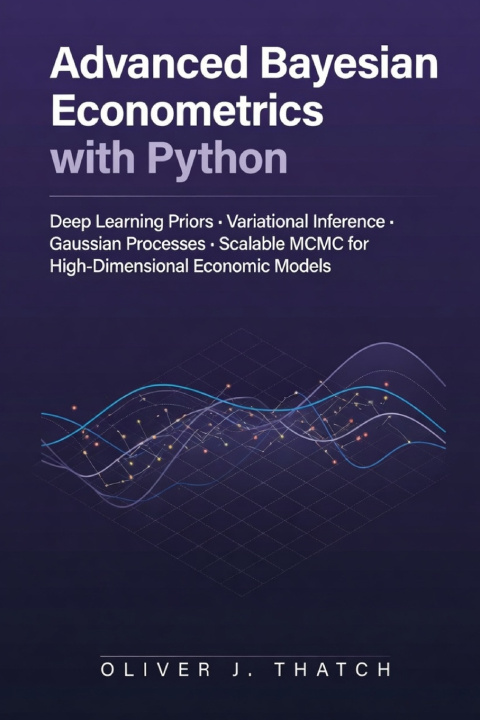
This book provides a comprehensive and practical treatment of advanced Bayesian econometrics using Python. It bridges modern machine learning techniques with traditional econometric modeling, offering detailed guidance on implementing state-of-the-art Bayesian methods for complex economic problems.
Readers will learn how to integrate deep learning priors, perform variational inference, work with Gaussian processes, and implement scalable MCMC algorithms tailored for high-dimensional economic models. The text emphasizes computational efficiency and practical application, addressing the challenges of estimation, uncertainty quantification, and model comparison in large-scale economic data.
Key topics include:
- Bayesian inference with neural network priors
- Variational methods for fast posterior approximation
- Gaussian process regression in econometric contexts
- Scalable MCMC techniques for high-dimensional parameter spaces
- Model selection, prediction, and policy analysis under uncertainty
- End-to-end Python implementations using contemporary libraries
Written for graduate students, researchers, and practitioners in economics, finance, and data science, this book assumes familiarity with intermediate statistics, Python programming, and basic Bayesian concepts. All methods are demonstrated with reproducible code examples that translate directly to real-world economic modeling tasks.
Clear explanations, mathematical derivations where needed, and practical coding guidance make this an essential resource for those seeking to move beyond standard econometric toolkits into more flexible and powerful Bayesian frameworks.