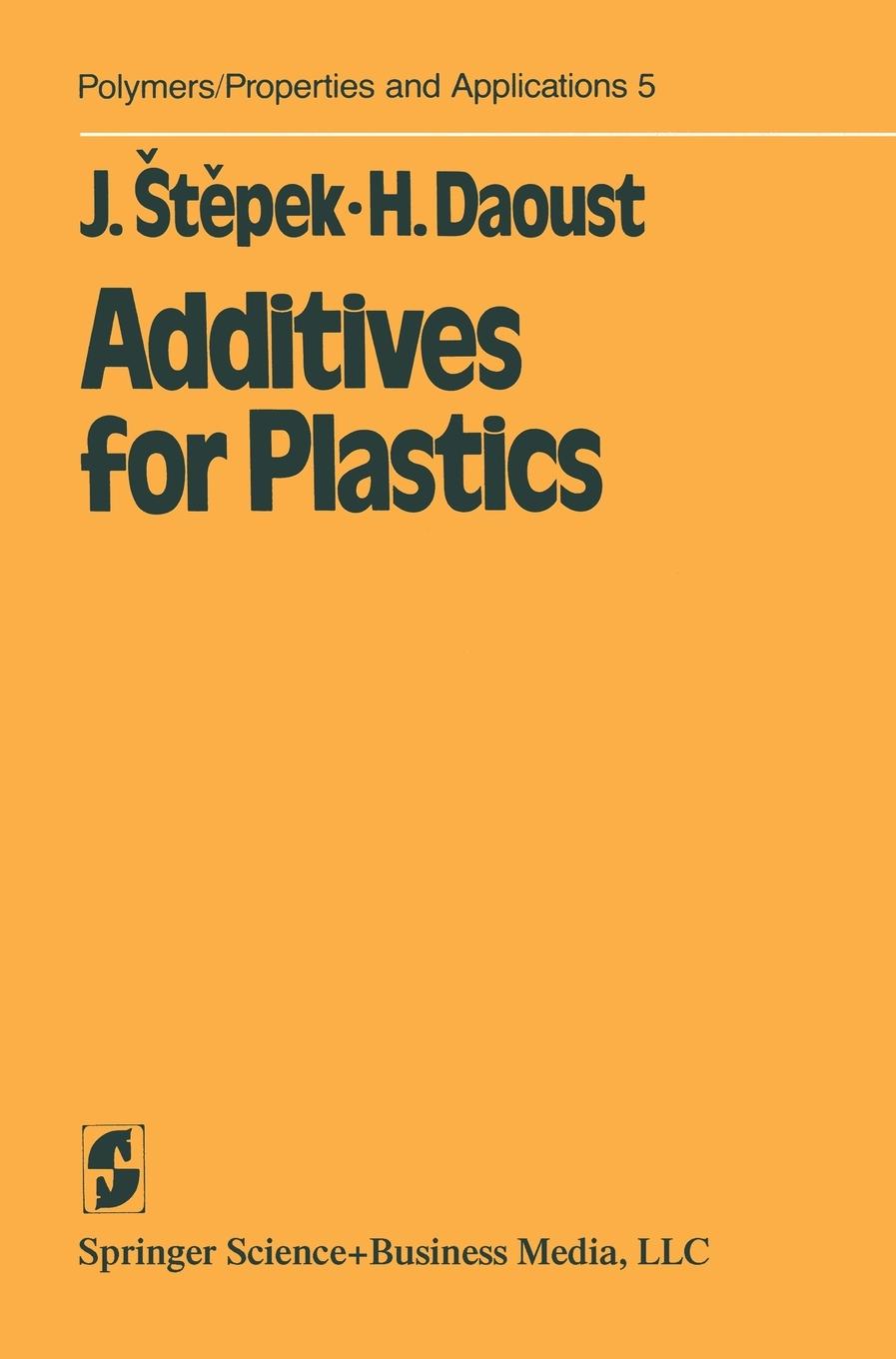
Kniha Additives for Plastics Jiri Stepek

Additives for Plastics

Jazyk: Angličtina
Väzba: Pevná
Vydavateľ: Springer, Berlin
Dostupnosť: Skladom u dodávateľa
Odosielame za 10-18 dní
94.99
I. Additives Which Modify Physical Properties.- 1 Plasticizers.- 1.1 Thermodynamic Basis of Macromol...
Informácie o knihe

Jazyk
Angličtina
Väzba
Kniha - Pevná
Vydalo
2013
Stránok
243
EAN
9780387907536
Enbook ID
01383746
Vydavateľ
Hmotnosť
675
Rozmery
172 x 250 x 19

Kompletný popis

I. Additives Which Modify Physical Properties.- 1 Plasticizers.- 1.1 Thermodynamic Basis of Macromolecular Mixtures.- 1.1.1 Solubility of Polymers in Solvents.- 1.1.2 Flory-Huggins Interaction Parameter.- 1.1.3 Solubility Parameter.- 1.1.4 Phase Separation Phenomena.- 1.2 Reversible Gelation.- 1.3 Theory of Plasticization.- 1.3.1 Effect of Plasticizers on Thermal Mechanical Deformation of Rigid Polymeric Chains.- 1.3.2 Effect of Plasticizers on Tb and Tg Values.- 1.3.3 The Free Volume in Amorphous Polymers.- 1.3.4 Primary and Secondary Plasticizers.- 1.4. Classification of Plasticizers.- 1.4.1 Polar Aromatic and Polar Aliphatic Plasticizers.- 1.4.2 Characteristics of Plasticizers According to Their Chemical Structure.- 1.5. Plasticizer Anomalies and Antiplasticization.- 1.6. Loss of Plasticizers.- References.- 2 Lubricants and Mold-Release Agents.- 2.1 Lubricants.- 2.1.1 Principles of Their Action.- 2.1.2 Classification of PVC Lubricants According to Their Specific Action.- 2.1.3 Classification of PVC Lubricants According to Their Chemical Structure.- 2.1.4 Lubricants for Polyolefins.- 2.1.5 Basic Properties Necessary for Lubricants.- 2.2 Mold-Release Agents.- 2.2.1 Principles of Action.- 2.2.2 Some Examples of Mold-Release Agents.- References.- 3 Macromolecular Modifiers.- 3.1 Introduction.- 3.2 Homogenization of Polymer-Polymer Systems.- 3.3 Two-Phase Microheterogeneous Polymer-Polymer Systems.- 3.3.1 Effect of Glassy Polymer Matrix Phase on Impact Strength.- 3.3.2 Effect of Rubbery Phase Dispersed in Glassy Matrix on Impact Strength.- 3.3.3 Theory on Toughness of Microheterogeneous Two-Phase Polymer-Polymer Blends.- 3.4 Impact Modifiers for Glassy Polymers.- 3.4.1 Chlorinated Polyethylene (CPE).- 3.4.2 Ethylene-(Vinyl Acetate) Copolymers (EVA).- 3.4.3 Acrylic and Methacrylic Elastomers and MBS and ABS Terpolymers.- 3.4.4 Rubbers.- 3.5 Macromolecular Modifiers Used as Polymer Processing Aids.- References.- 4 Reinforcing Fillers, Reinforcing Agents, and Coupling Agents.- 4.1 Fillers.- 4.1.1 General Characteristics of Fillers and Composites.- 4.1.2 Fillers for Thermosetting Resins.- 4.1.3 Fillers for Plastomers.- 4.1.3.1 Polymer Reinforcement Factors.- 4.1.3.2 Classification of Fillers for Plastomers According to Their Reinforcement Activity.- 4.2 Reinforcing Agents for Laminates.- 4.2.1 Effect of Fillers or Reinforcing Agents on Basic Physical Properties of Composites.- 4.3 The Different Types of Fillers and Reinforcing Agents.- 4.3.1 Glass Fillers and Reinforcing Agents.- 4.3.1.1 Glass Fibers.- 4.3.1.2 Glass Microspheres.- 4.3.1.3 Glass Flakes.- 4.3.2 Fillers and Reinforcing Agents Made of Other Materials.- 4.3.2.1 Fibrous and Flaky Fillers and Fibrous Reinforcing Agents.- 4.3.2.2 Whiskers, Microfibers, and Powdered Fillers.- 4.3.3 Effect of Content and Size of Fillers on Composite Properties.- 4.4 Coupling Agents.- 4.4.1 Silane Coupling Agents.- 4.4.1.1 Action Mechanism.- 4.4.2 Organotitanate Coupling Agents.- 4.4.2.1 Action Mechanism.- 4.4.3 Other Types of Coupling Agents.- 4.4.4 Application Modes for Coupling Agents.- 4.4.5 Recommendations on the Use of Fillers and Filling Methods.- References.- 5 Colorants and Brightening Agents.- 5.1 Colorants.- 5.1.1 Inorganic Pigments.- 5.1.2 Organic Pigments.- 5.1.3 Criteria for Selection of Pigments.- 5.2 Brightening Agents.- 5.3 Methods Used for the Coloration of Plastics.- 5.3.1 Some Examples of Methods Used for the Coloration of Most Important Plastics.- References.- 6 Chemical and Physical Blowing Agents.- 6.1 Chemical Blowing Agents.- 6.1.1 Inorganic Agents.- 6.1.2 Organic Agents.- 6.1.2.1 Characteristics.- 6.1.3 Factors Acting on Blowing.- 6.2 Physical Blowing Agents.- References.- 7 Antistatic Agents.- 7.1 Introduction.- 7.2 Efficiency and Mechanism of Antistatic Agent Action.- 7.3 The Use of Antistatic Agents.- 7.3.1 Antistatic Agents Containing Nitrogen.- 7.3.2 Antistatic Agents Containing Phosphorus.- 7.3.3 Antistatic Agents Containing Sulfur.- 7.3.4 Betaine-Type Antist...

Mohlo by vás zaujímať

Rev. John Bowle
Ralph Merritt Cox
30.25
55.13

Chicken Genius

Bernard Radfar
34.37
26.04

Matchbox Toys

Nick Jones
10.67

Dennis Fire Engines

Barry Hutchinson
16.54
15.56

The North American Review V194, Part 2 (1911)

North American Review Corporation
34.37
2.14
21.34
48.47
15.17

Again Again

Lockhart
9.39

Fragile Wisdom

Grazyna Jasienska
46.71

Sachiko

Shusaku Endo
30.94

Zákazníci, ktorí si kúpili túto knihu, kúpili tiež

56.70
16.64

ADARA

SEBASTIEN
20.66

ZUR TRAUUNG

HANS LANG
5.77
36.52

Der Täter hinter dem Täter

Friedrich-Christian Schroeder
50.14

"Ohne Steuer kein Staat"

Andreas Schwennicke
51.41
115.36
121.83
252.87
32.60
8.80